
Washington DOL Motorcycle Practice Test 6
Test 6 of 6. Pick an answer for each question to see if it is right and why; your score appears at the end. You need 40 correct answers to pass, the same ratio as the real Washington test.
- Questions50
- Correct to pass40
- Passing score80%
- Minimum age16 years
-
1. Your light turns green, but a vehicle is still in the middle of the intersection. What should you do?
Show answer
Answer D: Wait until the intersection is clear before you move ahead
A green light means go only when the way is clear. Drivers already inside the intersection must be allowed to finish crossing.
-
2. For a first Washington DUI conviction where the alcohol concentration is 0.15 or higher, what is the mandatory minimum jail term?
Show answer
Answer C: 48 hours
When the alcohol concentration is 0.15 or higher, Washington doubles the first-offense minimum jail term to 48 consecutive hours.
-
3. What is the highest speed limit a Washington local authority may set on a designated shared street?
Show answer
Answer B: 10 miles per hour
Washington law caps a locally designated shared street speed limit at 10 miles per hour.
-
4. You are in the middle lane of a one-way street with three lanes when a police car approaches from behind with lights and siren. What should you do?
Show answer
Answer C: Pull to the nearest curb and stop clear of the lanes
On a one-way street you clear to whichever curb is closest, so the emergency vehicle gets a clear path down the open lanes.
-
5. What limits how much weight a motorcycle can carry?
Show answer
Answer A: The load limit given by the manufacturer for that machine
The manufacturer's figure covers the rider, the passenger and everything carried, and going over it overloads the tires, the brakes and the suspension.
-
6. You are traveling in the same direction as a funeral procession and want to get ahead of it. What should you not do?
Show answer
Answer B: Driving in between the vehicles of the procession
Most states prohibit driving into or through a funeral procession, and cutting into the line leaves the drivers behind with no lead vehicle to follow, so go around only where passing is permitted.
-
7. Which ability does alcohol usually affect first?
Show answer
Answer A: Judgment and self control
Alcohol reduces judgment and inhibition before a drinker notices any clumsiness, which is why an impaired driver often feels perfectly capable while already driving worse.
-
8. You are driving at night on an unlit road using low beams. How should you choose your speed?
Show answer
Answer C: So you could stop within the distance your headlights light up
Driving faster than you can stop within the lit area is called overdriving your headlights. Anything beyond the beam is invisible until it is too late to react.
-
9. A sign with a yellow background and a black legend generally conveys
Show answer
Answer B: a general warning
Yellow is the background color used for general warning signs, so a yellow sign tells the driver to expect something ahead rather than to obey a rule.
-
10. A traffic signal is dark and you reach the intersection at the same moment as a vehicle on your right. Who goes first?
Show answer
Answer A: The vehicle on your right, as at any all-way stop
A dark signal is treated as an all-way stop, and the usual tie-breaker then applies: the vehicle on the right goes first.
-
11. What does Washington's distracted driving law say about electronic devices?
Show answer
Answer A: No driver may hold any electronic device while driving, regardless of age or experience
Washington prohibits every driver from holding any electronic device such as a phone, tablet or gaming device while driving, regardless of age or experience.
-
12. What blood alcohol concentration establishes driving under the influence for a Washington driver aged 21 or older, independent of the THC limit?
Show answer
Answer A: 0.08 percent or more
Washington sets the adult blood alcohol threshold for driving under the influence at 0.08 percent or higher, measured within two hours of driving.
-
13. How far before and after a qualifying stationary vehicle does Washington's move-over law define the protected zone?
Show answer
Answer C: 200 feet
Washington's move-over law defines the protected emergency or work zone as the adjacent lanes 200 feet before and after the qualifying vehicle.
-
14. On an overhead guide sign, the small exit number panel sits above the left-hand end rather than the right. What does that placement tell you?
Show answer
Answer A: The exit leaves from the left side of the roadway
The exit number plaque is placed on the side from which the ramp leaves, which gives advance notice of the unusual left-hand exit.
-
15. How does the penalty change for a second or subsequent violation of Washington's electronic device law?
Show answer
Answer D: It is doubled compared to the first-offense amount
Washington doubles the penalty amount for a second or subsequent violation of the personal electronic device law.
-
16. You and an oncoming driver are both turning left at the same intersection. What is the usual rule?
Show answer
Answer D: Both turn in front of each other unless markings show otherwise
The normal practice is to pass driver side to driver side, turning in front of one another, unless pavement markings or signs direct a different path.
-
17. Traffic is heavy and you find yourself riding level with a car in the next lane. What is the problem with staying there?
Show answer
Answer B: You sit in the driver's blind spot, so a lane change could hit you
Motorcycles disappear easily in a blind spot, so adjust your speed to ride ahead of or behind the other vehicle instead of beside it.
-
18. Your exit from a three-lane highway is about a mile ahead on the right, and you are in the left lane. What should you do?
Show answer
Answer B: Start moving right now, one lane at a time
Plan ahead and change lanes one at a time well before the exit, so you never have to cut across several lanes at the gore.
-
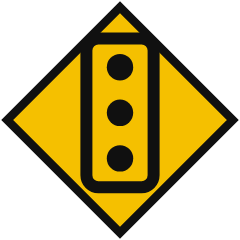
19. What does this sign require of the driver?
Show answer
Answer D: Reducing speed and being ready to stop at the intersection ahead
The advance notice asks the driver to slow and be ready to stop, while whether a stop is actually needed depends on the indication displayed on arrival.
-
20. A sign showing a figure with an outstretched thumb inside a red circle with a slash means that
Show answer
Answer B: soliciting a ride is prohibited there
The no hitchhiking sign bars standing beside the road to solicit a ride, and it is common along freeway ramps and shoulders.
-
21. What should you avoid when a hostile driver pulls alongside you?
Show answer
Answer A: Making eye contact, or answering the gestures in any way at all
Any response, including a look, encourages an aggressive driver, so give none and let the vehicle go.
-
22. What blood alcohol concentration brings DUI consequences for a Washington driver under 21?
Show answer
Answer C: 0.02 percent or more
Washington drivers under 21 face the same DUI consequences at a blood alcohol concentration of 0.02 percent or more, while the adult threshold is 0.08 percent.
-
23. The word SCHOOL is painted in large letters across the roadway. What is it doing?
Show answer
Answer D: Backing up the signs marking a school zone
Word markings on the pavement reinforce a message that is already signed, and a driver looking at the road ahead cannot miss them.
-
24. Blue pavement markings are used together with white markings at
Show answer
Answer D: parking spaces reserved for people with disabilities
Blue supplements the white markings of accessible parking spaces, which is the only assignment blue has on the pavement.
-
25. Does Washington's move-over statute explicitly cover an ordinary disabled vehicle that is only using its hazard lights, with no other warning equipment?
Show answer
Answer A: No, the law lists specific qualifying vehicles, and hazard lights alone are not one of them
Washington's move-over statute lists specific categories of qualifying vehicles and equipment, and an ordinary disabled vehicle using only its hazard lights is not one of them.
-
26. On a Washington roadway with four or more lanes, what does the move-over law require when a qualifying emergency or work zone vehicle is stopped ahead?
Show answer
Answer A: Change lanes away from the vehicle, or slow down if unsafe
On a roadway with four or more lanes, Washington's move-over law requires changing lanes away from the qualifying vehicle, or slowing down if a lane change is not safe.
-
27. Which use of a personal electronic device is exempt from Washington's driving ban?
Show answer
Answer B: Contacting emergency services to report an incident
Washington's electronic device law exempts using the device to contact emergency services.
-
28. When is it safe to return to your own lane after passing a vehicle?
Show answer
Answer C: Once you can see the whole front of that vehicle in your mirror
Seeing the entire front of the vehicle in the mirror proves there is a full vehicle length of clear road, which the rider cannot judge by feel alone.
-
29. When should most of your braking for a turn be finished?
Show answer
Answer B: Before you begin to turn the wheel
Slow to the right speed before the turn begins; braking hard while turning uses up the grip the tires need for steering.
-
30. How long is a driver's license revoked after a third Washington DUI conviction within seven years?
Show answer
Answer C: Three to four years
A third Washington DUI conviction within seven years results in a license revocation of three to four years.
-
31. A sign beside the signal reads STOP HERE ON RED. What does it tell you?
Show answer
Answer B: Stop at that point on red, not closer to the intersection
The sign marks the required stopping point, which is set back from the corner so that turning vehicles and sight lines are not blocked.
-
32. You approach a traffic signal that has already been green since it first came into view. What should you expect?
Show answer
Answer B: That it may change at any moment, so be ready to stop
A signal already green when you first see it is well into its cycle, so a rider covers the brakes and plans a stop rather than assuming a clear run.
-
33. You are stopped at a stop sign waiting to turn onto a highway where traffic moves at 55 mph. How should you choose your gap?
Show answer
Answer A: Wait for a much larger gap than the one you would accept on a city street
Fast traffic covers ground while you are still accelerating, so the gap that feels adequate at 25 mph is dangerously short at highway speed.
-
34. The rider behind you is closing right up on your machine and crowding you. What is the best response?
Show answer
Answer D: Let them go past and take a position behind them instead
Speeding up to escape a rider who is following too closely usually brings them with you, while letting them past removes the pressure entirely.
-
35. You are waiting to pull out of a driveway when a bicyclist comes along the bike lane in front of you. What must you do?
Show answer
Answer D: Wait until the bicyclist has gone past
A driver leaving a driveway yields to everything already on the road, and a bike lane is part of the roadway.
-
36. Why is it risky to brake hard and steer sharply at the same moment?
Show answer
Answer C: The tires have a limited amount of grip that braking and turning must share
Each tire can deliver only so much grip, and asking it to slow the vehicle and change direction at once can exceed that limit and start a skid.
-
37. Your passenger has ridden on other people's motorcycles before. What should you do before setting off?
Show answer
Answer A: Brief them anyway, because your machine and your instructions differ
Handholds, footrests, exhaust position and the signals a rider uses all vary from machine to machine, so every passenger is briefed on the machine they are about to ride on.
-
38. Why is parking against the flow of traffic dangerous even when nobody complains?
Show answer
Answer D: Because you had to cross traffic to get there and must cross again to leave
Parking on the wrong side means driving against traffic at both ends of the stop, and your reflectors and lights face the wrong way while you are there.
-
39. Why are sign shapes and colors standardized across the whole country?
Show answer
Answer D: So a driver knows the kind of message before reading it
Uniform shapes and colors let a driver classify a sign as regulatory, warning or guide from a distance, before the legend can be read.
-
40. Windblown sand has collected across the pavement at a rural intersection where you must stop. How should you handle the stop?
Show answer
Answer A: Do your braking on clean pavement before the sand, then roll across upright
Sand acts like ball bearings under the tires, so finish your braking on the clean surface ahead of it and cross the loose patch upright with no sudden inputs.
-
41. On a hot summer day you notice long black strips of crack sealant snaking across the pavement. What should a rider know about them?
Show answer
Answer A: They soften in heat and can be slippery, especially under a leaned tire
Crack sealant gets soft and greasy in the heat, so treat those strips as a low traction surface and avoid braking or hard cornering on them.
-
42. On a school speed limit sign, the part carrying the word SCHOOL is shown
Show answer
Answer A: in black on a fluorescent yellow-green background
The SCHOOL portion of the school speed limit sign uses the same fluorescent yellow-green background as school warning signs, while the speed portion keeps the standard regulatory appearance.
-
43. At night you are waiting to turn left and can see only the headlights of an approaching vehicle. Why should you allow a bigger margin?
Show answer
Answer D: Because lights alone make speed and distance hard to judge
With no other visual cues, two points of light give you very little information about how fast the vehicle is closing, so leave extra margin.
-
44. An oncoming vehicle at night has its high beams on and you are being dazzled. Where should you look?
Show answer
Answer A: Toward the right edge of your lane
Looking toward the right edge line keeps you on course while sparing your eyes the worst of the glare. Slow down and do not retaliate with your own high beams.
-
45. You are approaching a narrow bridge where the road has one lane in each direction and no shoulder. What should you do about passing?
Show answer
Answer B: Do not pass on or near the bridge
A narrow bridge gives neither vehicle anywhere to go, so passing is prohibited there in the same way as on a hill or in a tunnel.
-
46. You reach an intersection with no signs, signals or markings clearly before a vehicle that is approaching on your right. What is the rule?
Show answer
Answer B: You may go first because you got there first
At an uncontrolled intersection the first driver to arrive goes first; the yield to the right rule only settles a tie.
-
47. Why should a rider avoid riding through a puddle that spans the lane?
Show answer
Answer D: It can hide a deep hole or broken pavement under the surface
Standing water conceals what is underneath it, so treat a puddle as an unknown surface and go around it whenever you safely can.
-
48. You are behind a slow vehicle on a two-lane road and a marked passing lane begins a mile ahead. What is the sensible choice?
Show answer
Answer D: Wait for the passing lane rather than using the opposing lane
A passing lane lets you overtake without ever entering the lane used by oncoming traffic, which is far safer than a pass a minute earlier.
-
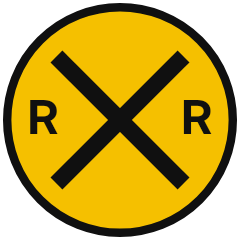
49. A driver sees this sign on a quiet road with no other traffic in either direction. What is the correct response?
Show answer
Answer C: Slow down, look and listen for a train, and be ready to stop
The sign gives advance notice of a highway-rail grade crossing, so the driver reduces speed, checks both directions along the tracks and keeps enough room to stop short of the rails.
-
50. At night you are judging your distance from the rider ahead by their tail light. What is the risk?
Show answer
Answer A: A single small light gives a poor sense of how far away it really is
Distance is very hard to judge from one small light in the dark, so riders should leave extra space rather than trust the impression the light gives.