
Washington DOL Motorcycle Practice Test 4
Test 4 of 6. Pick an answer for each question to see if it is right and why; your score appears at the end. You need 40 correct answers to pass, the same ratio as the real Washington test.
- Questions50
- Correct to pass40
- Passing score80%
- Minimum age16 years
-
1. Besides police and other emergency vehicles, which vehicle is specifically covered by Washington's move-over law when using compliant warning lights?
Show answer
Answer D: A tow truck displaying its required warning lights
Washington's move-over law specifically covers a tow truck making use of visual warning lights that meet the state's equipment requirements.
-
2. Under Washington's habitual offender law, how are multiple traffic offenses committed within six hours of each other counted on a first occurrence?
Show answer
Answer B: They are treated as a single offense on that first occasion
Washington's habitual offender statute treats multiple offenses committed within a six-hour period as one offense the first time this happens.
-
3. A flashing red lamp is mounted above a stop sign at a rural intersection. What does it add?
Show answer
Answer C: Emphasis, while the required stop stays the same
A stop beacon makes an easily missed stop sign more visible, but it neither adds to nor takes away from the obligation the sign already imposes.
-
4. Which sign tells you that the vehicles ahead are part of a funeral procession?
Show answer
Answer C: Headlights burning in daylight, with small flags or markers on the vehicles
Processions are normally identified by daytime headlights, hazard lights and flags or windshield markers, not by emergency lights or sirens.
-
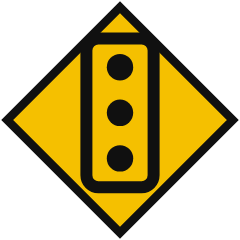
5. A driver passes this sign and the signal beyond it is already showing green. What is the safest response?
Show answer
Answer C: Ease off the accelerator and be ready to stop, because an indication that has been showing for a while is about to change
A signal that has been displaying the same indication for some time is close to changing, so arriving at a controlled speed with the brake covered is safer than accelerating to beat it.
-
6. Why do bridges and overpasses deserve extra caution when temperatures are near freezing?
Show answer
Answer A: They lose heat from above and below, so they ice over before the surrounding road
A bridge deck is exposed to cold air on both surfaces and has no ground beneath it to hold heat, so ice can form there while the connecting road is still only wet.
-
7. Which clue best warns a rider that the door of a parked car is about to open?
Show answer
Answer B: Someone visible in the seat, or exhaust showing at the tailpipe
Occupied cars are the ones that open doors, so scan through rear windows and mirrors and look for exhaust or wheels turning as you approach.
-
8. During which period does Washington law require headlights to be on?
Show answer
Answer B: From a half hour after sunset to a half hour before sunrise
Washington law requires headlights from a half hour after sunset to a half hour before sunrise.
-
9. Your lane is ending ahead in slow, heavy traffic and drivers in the next lane are already bumper to bumper. What is the recommended way to merge?
Show answer
Answer C: Take turns, one vehicle from each lane at the merge point
Alternating one for one at the merge point keeps both lanes moving and is the safest way to combine slow traffic.
-
10. What happens to a Washington driver's license if they default on an agreed installment plan for paying a court judgment from a crash?
Show answer
Answer A: The license is suspended until the judgment is satisfied
Washington suspends a driver's license when they default on an installment agreement for a judgment, and the suspension lasts until the judgment is satisfied.
-
11. What distinguishes negligent driving in the first degree from negligent driving in the second degree under Washington law?
Show answer
Answer D: First degree also requires evidence of alcohol or drug impairment
Negligent driving in the first degree is a misdemeanor requiring both negligent operation and evidence the driver was affected by alcohol, cannabis or another drug, unlike the impairment-free second degree infraction.
-
12. You want to turn left across the oncoming lane into a shopping center driveway. Who must you yield to?
Show answer
Answer B: Oncoming traffic and anyone using the sidewalk
A left turn into a driveway crosses both the oncoming lane and the sidewalk, so you give way to traffic and to pedestrians before completing it.
-
13. How long is a Washington motorcycle instruction permit valid and how many may a rider obtain?
Show answer
Answer B: 180 days, renewable one time, and only two permits within a 5-year period
A Washington motorcycle instruction permit expires after 180 days and may be renewed one time before it expires, and a rider is allowed only two permits within a 5-year period.
-
14. An officer directing traffic faces you and holds one hand up with the open palm toward your vehicle. What does the gesture mean?
Show answer
Answer D: Stop before reaching the officer
A raised open palm shown toward a driver is the standard signal to stop.
-
15. Is it safe to check your phone while stopped at a red light?
Show answer
Answer B: No, you may miss the signal change and hazards around you
Attention does not return instantly when the light changes, and emergency vehicles, pedestrians or a rear-end threat can appear while you are stopped. Stay focused on the road.
-
16. A bicyclist stops at a four-way stop just before you do. Who goes first?
Show answer
Answer B: The bicyclist, who reached the intersection and stopped there before you did
A bicyclist on the roadway follows the same right of way rules as a driver, so arrival order decides the turn.
-
17. Under Washington's implied consent law, how long can a driver lose the driving privilege for refusing a test?
Show answer
Answer B: 90 to 730 days, or until age 21, whichever is longer
Washington's implied consent law can cost a refusing driver the driving privilege for 90 to 730 days, or until reaching age 21, whichever is longer.
-
18. What do the numbers on a pedestrian countdown display show?
Show answer
Answer A: The seconds remaining to finish a crossing already under way
The countdown runs during the pedestrian change interval and shows how many seconds are left before the crossing time ends.
-
19. Which formation lets a group of riders stay close together while every rider keeps an adequate space cushion?
Show answer
Answer A: A staggered formation
A staggered formation keeps the group compact enough for traffic while still leaving each rider room to the front, the rear and both sides.
-
20. Which quality matters most in a face shield?
Show answer
Answer B: It resists penetration and is free of deep scratches
A shield has to stop objects thrown up from the road and stay clear enough for undistorted vision, and it needs some airflow so that it does not fog.
-
21. What happens when tires are driven underinflated for a long time?
Show answer
Answer D: They wear at the edges, they run hot and they are more likely to fail
An underinflated tire flexes too much, which wears the shoulders and builds up heat that can destroy the tire.
-
22. If a cited Washington driver later proves to the court that valid insurance existed at the time of the citation, what may the court assess before dismissing the case?
Show answer
Answer D: Up to $25 in administrative costs
Washington allows a court to assess up to $25 in administrative costs when dismissing a citation after the driver later proves valid coverage existed.
-
23. Traffic ahead of you has stopped in your lane while the next lane is still moving. What is the first thing to do?
Show answer
Answer C: Slow down first and check the next lane before moving over
Braking is the action that keeps you from hitting the stopped traffic, and the lane change is only safe once you have looked.
-
24. In T-CLOCS, what does the letter O stand for?
Show answer
Answer B: Oil and other fluid levels
The O step covers engine oil, along with coolant, hydraulic brake fluid and any final drive fluid, plus a look underneath for leaks.
-
25. What is the correct position for the feet while riding?
Show answer
Answer C: Firmly on the footrests with the toes level
Toes kept level stay clear of the pavement when the motorcycle leans and leave the foot ready to reach the brake pedal or shift lever.
-
26. Your motorcycle has a grab rail behind the passenger seat. What should the passenger know about using it?
Show answer
Answer C: It is fine to hold, but they must still brace against acceleration
A rail behind the passenger gives a secure grip but does nothing to stop them sliding backward, so they still need to expect the machine to pull away.
-
27. How does Washington's electronic device law treat a violation committed inside a marked crash prevention zone, such as a highway work zone?
Show answer
Answer B: The base penalty is doubled compared to a violation outside the zone
Washington doubles the base penalty for a personal electronic device violation committed inside a marked crash prevention zone.
-
28. What is wrong with slowing to a crawl at a stop sign and then rolling on through?
Show answer
Answer C: It is not a stop, and you may miss a pedestrian or cross traffic
A rolling stop is a violation and it also cuts short the moment you need in order to look carefully in each direction before entering.
-
29. What is the most effective way for a rider to be seen by other drivers?
Show answer
Answer C: Wear brightly colored reflective gear, or a reflective vest over dark clothing
The most common thing drivers say after a collision with a motorcycle is that they never saw it, and bright reflective gear on the helmet and torso is the largest visible surface the rider controls.
-
30. You are ready to pull out of a parallel parking space into the traffic lane. What should you do?
Show answer
Answer C: Signal, check the mirror and blind spot, and wait for a gap
A driver leaving a parking space must yield to traffic already in the lane, so signal, look for the gap and only then move out.
-
31. You are driving through a long curve on a road with two lanes in your direction. What is correct?
Show answer
Answer A: Stay within your own lane all the way through, adjusting speed before you enter
Wandering out of your lane in a curve puts you into the path of a vehicle you cannot see, and the slowing belongs before the curve rather than in it.
-
32. You are overtaking in a short passing lane on a two-lane road and it is about to end. What must you do?
Show answer
Answer A: Finish the pass and move back to the right before it ends
The added lane ends and the traffic returns to a single lane in each direction, so the pass has to be complete before the pavement runs out.
-
33. A sign at the signal reads LEFT TURN ON GREEN ARROW ONLY. The ball turns green but no arrow appears. What may you do?
Show answer
Answer C: Wait, because your turn is allowed only while the arrow is showing
The sign removes the permissive turn, so the left is legal only during the green arrow and you must wait behind the line until it appears.
-
34. A steady green arrow pointing left is displayed for your turning lane. What does it tell you?
Show answer
Answer D: The turn is protected because conflicting traffic is being held
A steady green arrow gives a protected movement in the direction shown, although you still yield to pedestrians and to any vehicle already inside the intersection.
-
35. Can a Washington court waive, reduce or suspend the fine for a move-over law violation?
Show answer
Answer D: No, the fine may not be waived, reduced or suspended
Washington law prohibits waiving, reducing or suspending the fine for a move-over law violation.
-
36. Along a highway the reference markers count upward as you travel. Where does the numbering normally begin?
Show answer
Answer C: At the southern or western edge of the state
Mileage numbering starts where the route enters the state from the south or the west, so rising numbers tell a driver which way they are heading.
-
37. You are riding where fresh pavement meets an older lane that sits an inch or two lower. How should you move across that edge?
Show answer
Answer A: Slow down and cross the edge at as sharp an angle as the lane allows
A pavement edge break can steer the front wheel along it if you meet it at a shallow angle, so slow, hold the bars firmly and cross it steeply.
-
38. In Washington, what is negligent driving in the second degree, and how is it penalized?
Show answer
Answer C: A $250 traffic infraction for negligent operation
Washington classifies negligent driving in the second degree as a traffic infraction with a $250 fine for operating a vehicle negligently in a way that endangers a person or property, without requiring proof of impairment.
-
39. Alcohol is classified as which kind of drug?
Show answer
Answer B: A depressant that slows the central nervous system
As a depressant, alcohol slows the brain and nervous system, which lengthens reaction time and dulls the coordination that driving depends on.
-
40. When a Washington local authority raises the speed limit on an arterial street after an engineering and traffic study, what is the maximum it may set?
Show answer
Answer D: 60 miles per hour
Washington caps a local authority's engineering-study-based arterial street speed limit at 60 miles per hour.
-
41. What do the overhead signals over a Washington reversible lane mean?
Show answer
Answer D: A green arrow means use the lane, a red X means do not, and a steady yellow X means the lane is changing direction
In Washington a green arrow permits use of the reversible lane, a red X forbids it, and a steady yellow X signals that the lane is changing direction so drivers should move out when safe.
-
42. Where should a rider with a disabled motorcycle try to stop?
Show answer
Answer D: Well clear of the traffic lanes, off the shoulder where there is room
Getting completely away from moving traffic protects the stopped rider and anyone helping, and a shoulder alone is not a safe place to work on a machine.
-
43. You are driving through a residential area where parked cars hide the side streets. What is the safest approach?
Show answer
Answer C: Slow down and cover the brake as you pass each opening
Where parked vehicles hide side streets and driveways, lower speed and a covered brake buy the time you lose in sight distance.
-
44. A pedestrian signal displays a steady walking person symbol. What does it mean for a pedestrian at that corner?
Show answer
Answer B: The pedestrian may start crossing in the direction of the signal
The steady walking person permits a pedestrian to begin the crossing, while still yielding to vehicles already lawfully in the intersection.
-
45. What should a group agree on before the ride begins?
Show answer
Answer A: The route, the fuel and rest stops, and the hand signals to be used
Settling the route, the stops and the signals before departure keeps the group together and avoids sudden, confusing decisions once it is moving.
-
46. On a motorcycle with a standard shift pattern, where is neutral found?
Show answer
Answer C: Between first gear and second gear
The usual pattern is one down and the rest up, with neutral sitting half a click between first and second gear.
-
47. What dollar amount in cash or approved securities may a Washington driver deposit with the state as an alternative to carrying liability insurance?
Show answer
Answer D: $60,000
Washington allows a driver to deposit $60,000 in cash or approved securities with the state as an alternative to carrying a liability insurance policy.
-
48. What should a pre-ride check of a belt final drive look for?
Show answer
Answer C: Correct tension, plus cracks, frayed edges and missing teeth
A belt is inspected for tension and for damage such as cracks, missing teeth and worn edges, and unlike a chain it is never lubricated.
-
49. You are leaving a freeway at an exit that has a deceleration lane. Where should you slow down?
Show answer
Answer C: After you have moved fully into the exit lane
Braking in a through lane surprises the traffic behind you, so you move into the exit lane at highway speed and then slow down inside it.
-
50. What is the basic rule for entering a roundabout?
Show answer
Answer B: Traffic already circulating goes first, and you wait for a gap
Entering traffic yields to vehicles already going around the circle, which is what keeps a roundabout moving instead of locking up.