
Washington DOL Motorcycle Practice Test 2
Test 2 of 6. Pick an answer for each question to see if it is right and why; your score appears at the end. You need 40 correct answers to pass, the same ratio as the real Washington test.
- Questions50
- Correct to pass40
- Passing score80%
- Minimum age16 years
-
1. Which of these vehicle types is exempt from Washington's standard proof-of-financial-responsibility statute?
Show answer
Answer A: A moped
Washington exempts mopeds, motor-driven cycles and wheeled all-terrain vehicles from the standard proof-of-financial-responsibility statute that applies to ordinary vehicles.
-
2. What triggers habitual traffic offender status for a Washington driver?
Show answer
Answer A: Three serious convictions, or twenty moving violations, within five years
Washington defines a habitual traffic offender as a driver with three or more serious offense convictions, or twenty or more moving violation convictions, within a five-year period.
-
3. An arrow panel in a work zone shows four flashing lamps in caution mode instead of an arrow. What does that display mean?
Show answer
Answer A: Warning only, so pass the work area with caution in your current lane
Caution mode gives a general warning without directing a lane change, so drivers stay alert and pass the activity with care.
-
4. Under Washington's open container law, where may a driver lawfully store an alcoholic beverage that has already been opened?
Show answer
Answer B: In the trunk of the vehicle
Washington law treats the glove compartment as part of the area occupied by driver and passengers, so an opened container must instead go in the trunk or a similarly separate area.
-
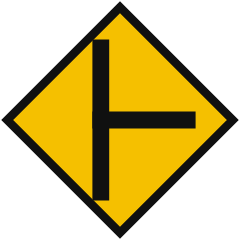
5. Approaching the point this sign refers to, which hazard is most likely?
Show answer
Answer A: A vehicle pulling out from the entering road into the driver's path
The main risk is a driver on the entering road who misjudges the gap and pulls out, so covering the brake and being ready to slow is the sensible response.
-
6. A white arrow painted in your lane points only to the right, and a sign above the lane shows the same movement. What must you do?
Show answer
Answer C: Turn right from that lane
Pavement arrows used with lane-use signs are regulatory, so a driver occupying that lane must make the movement shown.
-
7. Where is moped operation prohibited under Washington law?
Show answer
Answer D: On a fully controlled limited access highway or a sidewalk
Washington law prohibits operating a moped on a fully controlled limited access highway or on a sidewalk.
-
8. What phone rule applies to a Washington instruction permit or intermediate license holder?
Show answer
Answer A: No cell phone or mobile electronic device at all, even hands-free, except to report an emergency
Washington bars instruction permit and intermediate license holders from using a cell phone or any mobile electronic device while driving even if it is hands-free, and only allows use to report an emergency.
-
9. You will leave your vehicle for several hours after dark. Where is the best place to park it?
Show answer
Answer D: In a well-lit spot with people and cameras nearby
Light, passing people and cameras all discourage theft and make your own return to the vehicle safer.
-
10. What happens to your field of vision as your speed increases?
Show answer
Answer C: It narrows, so you notice less at the sides of the road
The faster you travel, the more your useful field of view narrows toward the center, so a hazard coming from the side is seen late or missed altogether.
-
11. Which clue tells you that a parked vehicle is about to pull into traffic?
Show answer
Answer D: Exhaust smoke, brake lights, front wheels turned out or a driver in the seat
A running engine, lit brake lights, turned wheels or a person behind the wheel all mean the vehicle may move. Slow down and give it room.
-
12. How does becoming chilled affect a rider before any shivering is obvious?
Show answer
Answer D: It slows reactions and clouds judgment while the rider still feels fine
Cooling degrades reaction time and decision making before the rider notices it, so dress for the coldest part of the ride and stop to warm up rather than pressing on.
-
13. A driver extends the left arm out the window and points it downward toward the road surface. What is being signaled?
Show answer
Answer A: Slowing down or stopping
The left arm extended downward is the standard hand signal for slowing or stopping.
-
14. What is the correct swerving technique?
Show answer
Answer D: Press the handgrip on the side you want to go and look toward the escape route
A swerve is two quick countersteering inputs, and because the motorcycle goes where the rider looks, the eyes belong on the open space.
-
15. How many vehicles must a person have registered in Washington to qualify as a self-insurer instead of carrying a policy?
Show answer
Answer C: More than 25
Washington allows a person with more than 25 vehicles registered in their name to qualify as a self-insurer.
-
16. Two solid white lines separate your lane from the lane beside it. What do they mean?
Show answer
Answer B: Crossing from one lane to the other is prohibited
A solid double white line marks a boundary that road users may not cross, such as the entrance to a preferential lane.
-
17. Absent any other posted limit, what speed does Washington law set as the maximum on city and town streets?
Show answer
Answer A: 25 miles per hour
Washington's basic speed statute sets 25 miles per hour as the default maximum on city and town streets when no other limit is posted.
-
18. You enter a work zone where the top layer of pavement has been milled off, leaving a grooved surface. How should you ride?
Show answer
Answer B: Hold a relaxed grip and steady speed, and expect the tires to wander
Milled or grooved pavement makes the tires follow the ridges and the motorcycle feel unsettled, so relax on the bars, keep a constant speed and ride straight through.
-
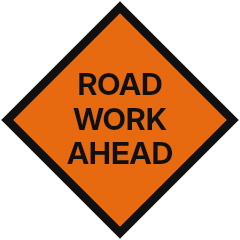
19. How should speed and following distance be adjusted beyond this sign?
Show answer
Answer D: Cut speed and leave a longer gap, because traffic can stop without warning
Traffic in these areas stops and starts unexpectedly and there is little room to steer around a problem, so extra space is what prevents a rear-end collision.
-
20. What is the minimum fine in Washington for riding a motorcycle without the required endorsement?
Show answer
Answer C: 389 dollars
Washington's current minimum fine for riding without a motorcycle endorsement is 389 dollars.
-
21. How should you handle a prescription or over the counter medicine before driving?
Show answer
Answer D: Read the label and ask a pharmacist or doctor whether it affects driving
Many common medicines, including allergy and cold remedies, cause drowsiness or slowed reactions, and the label or a pharmacist can tell you whether driving is safe.
-
22. How can you check that you are keeping a safe following distance?
Show answer
Answer A: Count at least three seconds between the vehicle ahead passing a fixed object and your reaching it
Pick a fixed roadside object, start counting when the vehicle ahead passes it and make sure at least three seconds elapse before you reach it, adding more time in poor conditions.
-
23. You are leaving a private driveway and entering a public street. What are you required to do?
Show answer
Answer B: Stop and yield to traffic on the street and to pedestrians on the sidewalk
A driver entering a roadway from a driveway, alley or private road must stop and yield to traffic on the roadway and to pedestrians on the sidewalk being crossed.
-
24. On a Washington roadway with fewer than four lanes, how does the move-over law say a driver should get past a qualifying stopped vehicle?
Show answer
Answer B: By passing to the left at a safe distance
On a roadway with fewer than four lanes, Washington's move-over law directs drivers to pass to the left at a safe distance.
-
25. A disabled vehicle is blocking your lane on a two-lane road with a single solid yellow line on your side. What should you do?
Show answer
Answer C: Wait until the oncoming lane is clear, then go around carefully
The solid line prohibits overtaking a moving vehicle, but in most states a driver may go around an obstruction such as a disabled vehicle once the oncoming lane is clear and the move can be made safely.
-
26. While you wait for the ambulance at a crash, what is the most useful help you can give?
Show answer
Answer C: Keep the person still and warm, and press down firmly on any heavy bleeding
Keeping an injured person still and warm and controlling bleeding are among the few things a bystander can safely do.
-
27. You are parked legally, but a police officer tells you to move the vehicle. What should you do?
Show answer
Answer B: Move it as directed, because an officer overrides the signs
Directions from a police officer or a firefighter take precedence over signs and markings, whether they are directing traffic or clearing a street.
-
28. What is the correct body position for riding over a bump or an obstacle?
Show answer
Answer B: Rise slightly off the seat with your weight on the footrests, absorbing the shock with knees and elbows
Coming slightly off the seat lets your legs and arms work as extra suspension instead of transferring the impact through your body and the handlebars.
-
29. In most states, how far before a turn must your signal already be on in city traffic?
Show answer
Answer B: At least 100 feet, roughly the length of six or seven cars
Most states require the signal for at least 100 feet before a turn in city driving, which gives drivers behind you time to react before you slow; several require more at higher speeds.
-
30. At what active THC concentration does Washington treat a driver aged 21 or older as driving under the influence?
Show answer
Answer C: More than 5 nanograms per milliliter of blood
Washington treats more than 5 nanograms of active THC per milliliter of blood as a DUI for drivers aged 21 and older, while any amount above zero applies to drivers under 21.
-
31. After turning right you see a sign showing that your lane ends a short way ahead. What should you do?
Show answer
Answer B: Signal and merge into the next lane while there is still room
Merge early and smoothly while a gap is still available, rather than running out of pavement or forcing your way in at the last moment.
-
32. How long is a driver's license revoked after a second Washington DUI conviction within seven years?
Show answer
Answer B: Two years
A second DUI conviction within seven years brings a minimum two-year Washington license revocation, which continues until sobriety program requirements under the DUI statute are also satisfied.
-
33. You must slow suddenly on a highway and a vehicle is following close behind you. What helps prevent a rear-end collision?
Show answer
Answer D: Tapping the brake pedal early so your brake lights flash a warning
Early brake light flashes give the driver behind more time to react, and slowing gradually instead of suddenly reduces the chance of being struck.
-
34. Why are ordinary denim jeans a poor choice for riding?
Show answer
Answer C: They wear through in a slide, giving little abrasion protection
Light denim abrades away in a fraction of a second on pavement, while leather or purpose made textile gear stays intact long enough to protect the skin underneath.
-
35. Another vehicle is passing you on a two-lane road. What should you do with your speed?
Show answer
Answer A: Hold your speed or ease off slightly to shorten the pass
Speeding up strands the passing driver in the oncoming lane, while a steady speed or a slight lift lets the pass finish quickly and safely.
-
36. The traffic signal is green, but the crossing lights on the tracks inside the intersection begin to flash. What must you do?
Show answer
Answer C: Stop clear of the tracks and wait, even though the signal is green
Active crossing warning devices outrank the green indication, so you stop short of the rails and wait until the warning stops.
-
37. You are in the middle of an intersection when you hear a siren and see an emergency vehicle approaching. What should you do?
Show answer
Answer A: Keep going, clear the intersection, then pull to the right and stop
Stopping inside an intersection blocks the emergency vehicle. Clear the intersection first, then pull over to the right and stop.
-
38. How can a cited Washington driver avoid the administrative cost when later proving insurance coverage to the court?
Show answer
Answer B: By mailing proof to the court before the hearing date
Washington waives the administrative cost when a cited driver mails proof of coverage to the court before the scheduled hearing date.
-
39. What does a NARROW BRIDGE warning sign tell a driver?
Show answer
Answer A: The bridge is tighter than the road leading up to it
A narrow bridge still carries both directions, but with much less clearance than the approaches, so drivers should slow and hold their lane position carefully.
-
40. The gates at a railroad crossing begin to come down as you approach. What must you do?
Show answer
Answer A: Stop and wait until the gates are fully raised and the lights stop flashing
Once the gates start down you must stop clear of the tracks and wait until they are fully raised and the warning lights have stopped.
-
41. You are driving on a road covered with a layer of wet fallen leaves. What should you expect?
Show answer
Answer B: As little grip as on ice, plus hidden markings and hidden holes
Wet leaves are as slippery as ice and they hide the lane lines and any potholes underneath, so slow well before curves and stops.
-
42. On an unlit road, about how far ahead do high beams normally let you see?
Show answer
Answer D: About 350 to 500 feet ahead of the vehicle
High beams light roughly 350 to 500 feet of road and low beams far less, which is why night speeds have to be chosen around the beam, not the limit.
-
43. In Washington you see a roadside response vehicle with flashing lights ahead. What must you do?
Show answer
Answer D: Move over into a farther lane, or slow to at least 10 miles per hour below the posted limit and never exceed 50 miles per hour in the zone
Washington requires drivers either to move over into a farther lane or to slow to at least 10 miles per hour below the posted limit, and never to drive faster than 50 miles per hour in an emergency zone.
-
44. You are stopped in a shared through and right-turn lane with your right signal on, and a bicyclist rides up along your right side. What should you do?
Show answer
Answer A: Let the bicyclist clear the intersection or move ahead before you turn
A cyclist alongside your right side is in the path your turn will sweep across, so wait until that space is clear before turning.
-
45. Where should the rider be looking during a U-turn?
Show answer
Answer B: All the way around toward the point where the turn will finish
A motorcycle follows the eyes, so turning the head to the exit of the turn keeps the machine coming round instead of drifting wide.
-
46. On a two-way street, where and how should you park at the curb?
Show answer
Answer C: On the right side, facing the way traffic moves
On a two-way street you must park on the right, headed in the direction of travel; parking facing traffic is prohibited.
-
47. What should you expect while driving through a parking lot?
Show answer
Answer D: Pedestrians and vehicles moving from any direction, so drive slowly
Parking lots mix walking people, reversing vehicles and poor sight lines, so low speed and constant scanning are the only reliable protection.
-
48. You have just merged onto a freeway from an entrance ramp. What should you do next?
Show answer
Answer C: Settle into the right lane and build up speed before changing lanes
Crossing lanes while you are still below the speed of the traffic forces other drivers to brake, so the speed comes first and the lane change second.
-
49. What should a rider do before riding an unfamiliar or borrowed motorcycle?
Show answer
Answer B: Locate and try the controls, then ride cautiously until used to the machine
Turn signals, horn, headlight switch, fuel valve and engine cut-off switch sit in different places on different models, and hunting for them in traffic is dangerous.
-
50. How does Washington calculate the fine for violating the move-over law?
Show answer
Answer C: It equals twice the standard infraction penalty
Washington sets the fine for a move-over law violation at twice the penalty assessed under the standard traffic infraction schedule.