
Washington DOL Permit Practice Test 8
Test 8 of 10. Pick an answer for each question to see if it is right and why; your score appears at the end. You need 32 correct answers to pass, the same ratio as the real Washington test.
- Questions40
- Correct to pass32
- Passing score80%
- Minimum age15 years
-
1. During which period does Washington law require headlights to be on?
Show answer
Answer B: From a half hour after sunset to a half hour before sunrise
Washington law requires headlights from a half hour after sunset to a half hour before sunrise.
-
2. What does Washington law say about wearing headphones or earbuds while driving?
Show answer
Answer D: It is against the law to drive while wearing earbuds, earphones, headphones or headsets that broadcast sound or cancel noise
Washington makes it illegal to drive while wearing earbuds, earphones, headphones or headsets that broadcast sound or cancel noise, although a compliant hands-free device may be used in one ear.
-
3. You are in the right-hand lane of a multilane street and that lane becomes a right-turn-only lane ahead, but you want to go straight. What should you do?
Show answer
Answer B: Change into a through lane before you reach the markings for the turn lane
A lane-use arrow is a regulatory marking, so a driver who wants to continue straight has to leave that lane before it becomes a mandatory turn lane.
-
4. A crash happens directly in front of you and vehicles are blocking both lanes. What should you do?
Show answer
Answer B: Stop at a safe distance, put on the hazards and warn the traffic behind
The greatest danger after a crash is a second collision, so stop short of it and make sure the traffic behind you can see the problem.
-
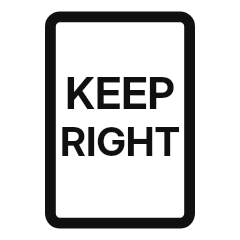
5. Where is this sign normally installed?
Show answer
Answer A: At an island or other obstruction in the roadway, to show which side traffic must take
It is placed at a divider, island or fixed obstruction so that drivers approaching it know without hesitating which side to pass on.
-
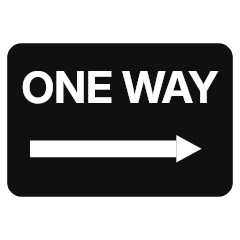
6. Where are signs of this kind placed at an intersection?
Show answer
Answer C: At the near right and far left corners, facing drivers on the intersecting street
They are installed at the corners of the intersecting street so that a driver about to turn in sees the restriction before committing to the turn.
-
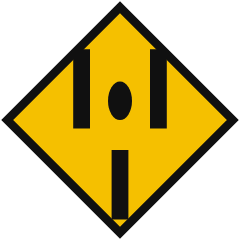
7. What should a driver do first after passing this sign?
Show answer
Answer A: Move into the right-hand lane and stay there
Traffic returns to two-way operation, so the driver keeps to the right of the centerline and stops treating the left side as available.
-
8. Under Washington's ban on personal electronic devices while driving, which brief action remains legally allowed?
Show answer
Answer C: Using a single finger to activate or deactivate a device function
Washington's electronic device law permits the minimal use of a single finger to activate, deactivate or initiate a function, even though holding and reading the device is otherwise banned.
-
9. A hot drink tips over onto your lap while you are driving. What should you do?
Show answer
Answer A: Keep hold of the wheel and stop when it is safe
The spill is painful but the crash risk comes from letting go of the wheel or braking suddenly, so keep control and deal with it once you are stopped.
-
10. Two people drink the same amount of alcohol at the same time. Why might their blood alcohol concentrations differ?
Show answer
Answer C: Body weight, gender and food in the stomach affect the concentration
Smaller people and, on average, women reach higher concentrations from the same amount of alcohol, and an empty stomach speeds absorption. Counting drinks alone does not tell you your level.
-
11. An orange sign showing the symbol of a person holding a flag or a sign paddle means that
Show answer
Answer D: a person is controlling traffic ahead and the driver must obey that person
The flagger sign warns that a trained flagger is directing traffic further on, and the flagger's instructions govern movement through the work zone.
-
12. A ball rolls into the street from between parked cars ahead of you. What should you expect and do?
Show answer
Answer A: Expect a child to follow it and be ready to stop
A ball is usually followed by a child who is watching the ball and not the traffic. Slow down and be prepared to stop immediately.
-
13. Why is being predictable an important part of driving safely?
Show answer
Answer A: Because other road users are able to plan around what you are doing
Other drivers make their decisions from what they expect you to do, so surprises are what produce collisions.
-
14. Rain is falling and the outside temperature reads close to 32 degrees Fahrenheit. Why is that dangerous?
Show answer
Answer A: The rain can freeze on contact and glaze the road with ice
Near freezing, rain landing on cold pavement can turn to a glaze of ice almost at once, so a road that looks merely wet may have no grip at all.
-
15. The car ahead of you slows down for no reason that you can see. Should you pull out and pass?
Show answer
Answer B: No, find out why it is slowing before you commit to the other lane
A driver usually slows for something, such as a turn, a hazard or a pedestrian, and that something is often exactly where your pass would take you.
-
16. A yellow sign reads SOFT SHOULDER. What is it telling you?
Show answer
Answer C: The shoulder may not carry the weight of a vehicle
A soft shoulder is unpaved and can let a wheel sink, so a driver who leaves the pavement there may lose control or become stuck.
-
17. You are stopped at a stop sign on a two-way stop intersection and the cross street has no stop signs at all. What does that mean for you?
Show answer
Answer A: You yield to all cross traffic no matter how long that takes
At a two-way stop only your direction is controlled, so there is no taking turns; you wait for a gap big enough to enter safely.
-
18. Which driver is exempt from Washington's electronic device restrictions while performing their duties?
Show answer
Answer B: An operator of an authorized emergency vehicle
Washington's electronic device law exempts operators of authorized emergency vehicles while performing their duties.
-
19. What does Washington insurance law require regarding underinsured motorist coverage on a new auto policy?
Show answer
Answer B: Insurers must include it unless rejected in writing
Washington requires insurers to include underinsured motorist coverage in new auto policies unless the named insured or spouse rejects it in writing.
-
20. In a work zone a flagger is directing traffic in a way that conflicts with the posted signs. Whom do you follow?
Show answer
Answer B: The flagger's directions
A flagger controls traffic through a work area that changes from day to day, and those instructions take precedence over the fixed signs and markings in that zone.
-
21. At a four-way stop you and an opposing driver arrive together. You are going straight and the other driver is turning left across your path. Who goes first?
Show answer
Answer B: You do, because the left turn crosses your path
When two opposing drivers arrive together, the one going straight goes first and the left-turning driver yields.
-
22. Two left-turn lanes are marked at the intersection and you are in the left one. What must you do?
Show answer
Answer A: Stay in your own lane all the way around the turn
With dual turn lanes each driver must hold a lane through the whole turn and come out in the matching lane of the new street.
-
23. You are about to pass another vehicle at night with your high beams on. What should you do?
Show answer
Answer C: Switch to low beams as you come up behind it and while you are alongside
High beams shining into the mirrors of the vehicle ahead blind the very driver whose reaction you depend on during the pass.
-
24. Which of these vehicle types is exempt from Washington's standard proof-of-financial-responsibility statute?
Show answer
Answer A: A moped
Washington exempts mopeds, motor-driven cycles and wheeled all-terrain vehicles from the standard proof-of-financial-responsibility statute that applies to ordinary vehicles.
-
25. What does a traction control system do?
Show answer
Answer A: It limits wheel spin when you accelerate
Traction control cuts power or brakes a spinning wheel so the tires can grip when you pull away or accelerate on a slippery surface.
-
26. What passenger restriction applies during the first 6 months of a Washington intermediate driver license?
Show answer
Answer A: No passengers under age 20 except immediate family members
For the first 6 months a Washington intermediate license holder may not carry passengers under age 20 except immediate family members.
-
27. What reinstatement fee does Washington charge to restore a license suspended or revoked specifically for a DUI or test-refusal violation?
Show answer
Answer A: $170
Washington charges an enhanced $170 reinstatement fee for a license suspended or revoked for driving under the influence or refusing a chemical test.
-
28. Where is a road work ahead sign placed?
Show answer
Answer B: In advance of the work space or detour, so drivers are warned before reaching it
Advance warning signs are placed upstream of the work space or detour so that drivers have time to slow down and change lanes before reaching the activity.
-
29. During what period does Washington law generally allow studded tires?
Show answer
Answer C: November 1 to April 1
Washington generally allows studded tires from November 1 through April 1.
-
30. A pedestrian near the curb is staring at a phone and not looking at traffic. What should you do?
Show answer
Answer A: Slow down and be ready to stop, because the pedestrian may step out without looking
Distracted pedestrians step into the street without checking. Assume they have not seen you and give yourself time and space to stop.
-
31. A vehicle in front of you has already begun turning left into a driveway when the gap you were waiting for opens up. What should you do?
Show answer
Answer B: Wait and let that driver finish the turn
A vehicle that has lawfully started a maneuver keeps the right of way until it is finished.
-
32. A delivery truck is parked in your lane and you must use the oncoming lane to get around it. Who has the right of way?
Show answer
Answer D: The oncoming traffic, because their lane is clear
The driver whose own lane is obstructed waits, because using the other lane is a favor from oncoming traffic, not a right.
-
33. You are overtaking in a short passing lane on a two-lane road and it is about to end. What must you do?
Show answer
Answer A: Finish the pass and move back to the right before it ends
The added lane ends and the traffic returns to a single lane in each direction, so the pass has to be complete before the pavement runs out.
-
34. Does Washington's personal electronic device ban still apply to a driver who is temporarily stopped at a red light in traffic?
Show answer
Answer A: Yes, because momentary stops in traffic still count as driving under the law
Washington's electronic device law defines driving to include being temporarily stationary because of traffic, a traffic control device, or other momentary delays.
-
35. You have started to pass and you see the no-passing zone beginning ahead. What should you do?
Show answer
Answer D: Ease off, drop back and return to your own lane
A pass must be completed before the no-passing zone starts. If it will not fit, abandon it and slot back in behind.
-
36. Someone has stepped into a marked crosswalk in the middle of a block ahead of you. What should you do?
Show answer
Answer A: Slow down, stop before the markings and let the person cross the street
A marked mid-block crosswalk carries the same duty as one at a corner: give way to the person crossing, stopping if that is what letting them cross safely takes.
-
37. You are making a U-turn at a signal on a green left arrow. Who must you still watch for?
Show answer
Answer D: People in the crosswalk you will cross as you come around
Even a protected arrow does not clear the crosswalk, and a U-turn sweeps across a crosswalk that pedestrians may already be using.
-
38. What blood alcohol concentration establishes driving under the influence for a Washington driver aged 21 or older, independent of the THC limit?
Show answer
Answer A: 0.08 percent or more
Washington sets the adult blood alcohol threshold for driving under the influence at 0.08 percent or higher, measured within two hours of driving.
-
39. You come up behind a bicyclist who is descending a steep hill in the middle of the traffic lane. What should you take into account?
Show answer
Answer D: The rider may be moving at close to the speed of the traffic
A bicycle can reach the speed of traffic on a descent, so there is little to gain from a pass and the rider needs the whole lane to steer around surface hazards.
-
40. On a two-lane road, a solid yellow line runs on your side of the center while a broken yellow line runs on the other side. What does this mean?
Show answer
Answer D: You may not pass, although oncoming drivers may
Passing restrictions are read from the line closest to your own lane, so a solid yellow line on your side creates a no-passing zone for you alone.