
Washington DOL Permit Practice Test 3
Test 3 of 10. Pick an answer for each question to see if it is right and why; your score appears at the end. You need 32 correct answers to pass, the same ratio as the real Washington test.
- Questions40
- Correct to pass32
- Passing score80%
- Minimum age15 years
-
1. A truck passes you in heavy rain and its spray blanks out your windshield. What should you do?
Show answer
Answer B: Hold the wheel steady, ease off slightly and let the wipers clear it
The blackout lasts a second or two. Keeping your line and easing off is far safer than braking hard or steering blind toward the shoulder.
-
2. A sign with a yellow background and a black legend generally conveys
Show answer
Answer B: a general warning
Yellow is the background color used for general warning signs, so a yellow sign tells the driver to expect something ahead rather than to obey a rule.
-
3. Two vehicles reach a four-way stop at the same moment from adjacent roads. Who should go first?
Show answer
Answer A: The driver on the right
When two drivers stop at a four-way stop at the same time, the driver on the left yields to the driver on the right.
-
4. Under what combination of conditions may Washington waive the standard driver training requirement for a minor applicant?
Show answer
Answer C: When the course wasn't available, a real need exists, and safe driving is shown
Washington may waive the driver training requirement when the applicant was unable to complete the course, has a legitimate need to drive, and can operate a vehicle safely.
-
5. You are stopped at the yield line of a roundabout when an emergency vehicle comes up behind you with lights and siren. What should you do?
Show answer
Answer A: Stay out of the roundabout and pull over to the right of your lane if there is room
Never enter a roundabout ahead of an emergency vehicle and never stop inside one; wait clear of the entry so the crew can get through.
-
6. You are in the right-hand of two left-turn lanes and the vehicle beside you starts to drift toward your lane during the turn. What should you do?
Show answer
Answer B: Slow slightly, keep to your own lane and give the other vehicle room
Drivers commonly drift wide in dual turn lanes, so hold your own line, ease off and leave space rather than racing or crowding the other vehicle.
-
7. You are backing a trailer and want its rear to move to the left. Which way should you turn the steering wheel?
Show answer
Answer A: Move the bottom of the wheel to the left, which turns the top to the right
A trailer moves opposite to the tow vehicle's steering when backing. Holding the wheel at the bottom and moving your hand in the direction you want the trailer to go makes this easier.
-
8. Why should the washer reservoir hold proper washer fluid rather than plain water in winter?
Show answer
Answer D: Water freezes and it leaves you with no way at all to clean the glass
Washer fluid contains antifreeze, so it still works in the cold, whereas water freezes in the reservoir and the lines.
-
9. Visibility drops suddenly and you decide to leave the highway. What is the safest way to do it?
Show answer
Answer A: Take the next exit or a wide pull off, well clear of the traffic lanes
Get right off the traveled way, and off the shoulder too if you can, because vehicles in poor visibility often drift onto the shoulder.
-
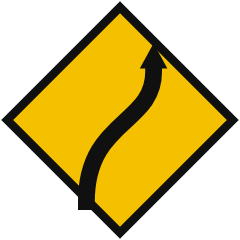
10. What does this sign tell a driver about the road ahead?
Show answer
Answer A: The roadway changes direction ahead, so speed should be reduced before reaching it
It gives advance notice of a change in alignment so the driver can slow down before entering, since braking inside a bend uses up grip that is needed for steering.
-
11. Some drivers believe they can multitask while driving. What does research show?
Show answer
Answer C: The brain switches rapidly between tasks and driving performance suffers
The brain does not truly do two attention-demanding tasks at once; it alternates between them, and the driving task gets less attention each time.
-
12. Your vehicle breaks down on a busy highway. What is the safest course of action?
Show answer
Answer D: Get it as far off the roadway as possible, switch on the hazard lights and keep clear of the traffic lanes
A vehicle left in or beside a travel lane is a hazard, so move it well off the road, make it conspicuous with hazard lights and keep yourself away from passing traffic.
-
13. You must leave your vehicle beside a narrow rural road at night. What should you do?
Show answer
Answer B: Get it right off the pavement and switch on the hazard lights
A vehicle left on an unlit rural road is very hard to see, so move it completely clear of the traveled surface and mark it with the hazard lights.
-
14. After the first 6 months and until age 18, how many passengers under age 20 may a Washington intermediate license holder carry?
Show answer
Answer C: No more than three, except immediate family members
From 6 months until age 18 or one year of safe driving, a Washington intermediate license holder may carry no more than 3 passengers under age 20, not counting immediate family members.
-
15. How long can cannabis affect a driver?
Show answer
Answer A: For hours after the strongest effects have passed
Slowed reactions, poor tracking and weak judgment of distance can last for hours, well beyond the point where the user believes the effects are over.
-
16. Why are pedestrians and cyclists a special risk on unlit streets at night?
Show answer
Answer A: Dark clothing can make them invisible until they are very close
A person in dark clothing reflects almost no light and may not appear until they are inside your stopping distance, so cut your speed where people may be about.
-
17. Where among these is parking specifically prohibited?
Show answer
Answer A: On a bridge, in a tunnel or on railroad tracks
Bridges and tunnels have no safe refuge and cannot be widened, and a vehicle left on railroad tracks cannot be avoided by an approaching train.
-
18. You reach a four-way stop after another driver has already stopped there. What should you do?
Show answer
Answer D: Let the driver who stopped first proceed before you go
At a four-way stop the vehicles proceed in the order they arrived, so a driver who stopped before you goes first.
-
19. How does the penalty change for a second or subsequent violation of Washington's electronic device law?
Show answer
Answer D: It is doubled compared to the first-offense amount
Washington doubles the penalty amount for a second or subsequent violation of the personal electronic device law.
-
20. An exit ramp is separated from the highway by a triangle of pavement painted with white stripes. What may you do there?
Show answer
Answer C: Nothing; keep off it and choose either the lane or the ramp
The striped area between a ramp and the through lanes is not for driving, stopping or last-second changes of direction.
-
21. How does being tired change your total stopping distance?
Show answer
Answer A: It lengthens it, because you take longer to notice and react
Fatigue stretches perception and reaction time, and every extra fraction of a second is added distance before the brakes even begin to work.
-
22. A curb sign reads 2 Hour Parking, 8 AM to 6 PM, Monday to Saturday. When may you stay longer than two hours?
Show answer
Answer A: Outside those hours and on Sundays
A time limit applies only during the days and hours printed on the sign; outside them the ordinary parking rules apply.
-
23. How long should a glance at a mirror or an instrument take?
Show answer
Answer A: A brief glance of about a second, returning your eyes to the road at once
Checks should be quick flicks of the eyes. At highway speed, a few seconds with your eyes off the road covers a distance long enough for a hazard to appear.
-
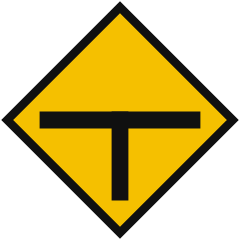
24. What must a driver be prepared to do at the point this sign refers to?
Show answer
Answer D: Turn left or right, because the road being traveled ends there
The road ends at another roadway, so the driver must slow, give way to traffic on the through road and turn in one direction or the other.
-
25. A bicyclist in the bike lane ahead of you signals and starts to move left toward the turn lane. What should you do?
Show answer
Answer A: Slow down and let the rider move across
A bicyclist who needs to leave the bike lane to turn left is changing lanes like any driver, and following traffic should make room.
-
26. You are very angry after an argument and about to drive. What should you know?
Show answer
Answer A: Strong emotions can impair judgment and attention much like alcohol
Anger, grief and stress pull attention inward and encourage risk taking. Give yourself time to settle down before getting behind the wheel.
-
27. Washington's basic speed rule requires a driver's speed to be reasonable and prudent with regard to what kind of hazards?
Show answer
Answer B: Hazards that exist now and hazards that could develop
Washington's basic speed statute requires drivers to have regard for both actual, currently existing hazards and potential hazards that could develop.
-
28. Your vehicle has antilock brakes. What should you never do in an emergency stop?
Show answer
Answer A: Pump the pedal up and down
The system already releases and reapplies the brakes many times a second. Pumping the pedal interrupts it and makes the stop longer.
-
29. What minimum liability coverage does Washington require a driver to carry proof of?
Show answer
Answer B: 25,000 dollars per person, 50,000 dollars per collision and 10,000 dollars property damage
Washington requires liability coverage of at least 25,000 dollars for injury or death of one person, 50,000 dollars for two or more people, and 10,000 dollars for property of others.
-
30. In which crash must the police always be notified?
Show answer
Answer D: Any crash in which somebody has been injured or killed, whatever the damage
Injury or death always makes a crash reportable, whatever the amount of vehicle damage or the opinions of the drivers.
-
31. Your car has side curtain airbags. What should you avoid doing?
Show answer
Answer B: Resting your head against the window or the door pillar
A side airbag deploys from the pillar or roof rail, so a head leaning against that area is directly in its path.
-
32. What dollar amount in cash or approved securities may a Washington driver deposit with the state as an alternative to carrying liability insurance?
Show answer
Answer D: $60,000
Washington allows a driver to deposit $60,000 in cash or approved securities with the state as an alternative to carrying a liability insurance policy.
-
33. Which driver is required to renew a Washington license in person rather than online?
Show answer
Answer A: A driver who is 70 years of age or older
Washington requires drivers who are 70 years of age or older to renew their license in person rather than online.
-
34. How far in advance of expiration can a Washington driver begin the license renewal process?
Show answer
Answer B: One year before expiration
Washington allows a driver to begin renewing a license up to one year before it expires.
-
35. What is the minimum ignition interlock restriction period for a third or subsequent Washington DUI conviction?
Show answer
Answer A: Ten years
A third or subsequent Washington DUI conviction carries a minimum ten-year ignition interlock restriction.
-
36. What blood alcohol concentration brings DUI consequences for a Washington driver under 21?
Show answer
Answer C: 0.02 percent or more
Washington drivers under 21 face the same DUI consequences at a blood alcohol concentration of 0.02 percent or more, while the adult threshold is 0.08 percent.
-
37. Your passengers are being noisy and you are losing concentration. What should you do?
Show answer
Answer B: Ask them to settle down, or pull over safely until they do
The driver is responsible for the conditions inside the vehicle, and stopping is always better than driving distracted.
-
38. What must the Washington Department of Licensing find before issuing a third instruction permit to the same applicant?
Show answer
Answer B: That the applicant is diligently improving driving skill
Washington requires an investigation finding that the applicant is diligently seeking to improve driving proficiency before issuing a third instruction permit.
-
39. Which combination best reduces the chance of hydroplaning?
Show answer
Answer D: Good tread depth, correct tire pressure and lower speed in the rain
Tread channels water away, correct pressure keeps the tire's shape, and lower speed gives the tire time to push water aside. Hydroplaning can begin at surprisingly modest speeds.
-
40. Why is being thrown out of a vehicle in a crash so dangerous?
Show answer
Answer C: Because you strike the road or other objects at high speed, and rarely survive
Ejection is one of the deadliest outcomes of a crash, and a fastened belt is what keeps a person inside the vehicle.