
Washington DOL Motorcycle Practice Test 26
- Questions50
- Correct to pass40
- Passing score80%
- Minimum age16 years
-
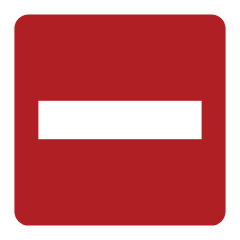
1. At which location is this sign normally installed?
Show answer
Answer D: Facing traffic that could turn into a one-way roadway or ramp against the flow
It is posted where a driver could otherwise enter a ramp or a one-way roadway from the wrong end, so it faces exactly the traffic that has to be kept out.
-
2. You have turned right into the nearest lane but you need the left lane soon. When should you move over?
Show answer
Answer A: After the turn is finished, once you have checked mirrors and blind spot
Complete the turn in the proper lane first, then make a normal lane change with mirror and blind spot checks once you are established on the new street.
-
3. A driver ahead of you extends the left arm straight out horizontally through the window. What is being signaled?
Show answer
Answer C: A left turn
The left arm held straight out is the standard hand signal for a left turn.
-
4. A dog is running toward the road from a yard ahead of you. Why is it a mistake to simply accelerate past it?
Show answer
Answer A: A dog aims at where you will be, so more speed can bring you together
A dog runs at an intercept point rather than at where you are now, which is why the recommended technique is to slow as you approach and then accelerate away once you are beside it.
-
5. A SHOULDER DROP OFF sign warns that
Show answer
Answer B: there is a step down from the pavement to the shoulder
The sign is used where the edge of the pavement stands several inches above the shoulder, which can grab a wheel and pull the vehicle sideways.
-
6. At a freeway exit, the paved triangle between the ramp and the through lanes is filled with diagonal white lines. What do they mean?
Show answer
Answer A: Stay out of that area, because it is not meant to be driven on
Chevron and diagonal markings fill paved areas that traffic is not intended to use, so drivers should keep out of them.
-
7. How can a rider check the action of the front suspension while the motorcycle is stationary?
Show answer
Answer D: Hold the front brake on and push down on the bars to feel the forks move and return
Compressing the forks against the front brake shows whether they move smoothly and return without binding, sticking or making noise.
-
8. You are stopped at a steady red arrow pointing right, and no sign or state rule permits turning on a red arrow. May you turn right?
Show answer
Answer A: No, you must wait until the red arrow goes out and a green signal appears
A steady red arrow prohibits the movement it points to until a signal permitting it appears. Only a posted sign or a specific state rule allows a turn on a red arrow after a complete stop, so without one you must wait.
-
9. You are leaving a freeway on an exit ramp posted with an advisory speed of 25 mph. Where should you slow to that speed?
Show answer
Answer A: In the deceleration lane, before you reach the curve of the ramp
Slowing belongs in the deceleration lane so you arrive at the curve already at the advisory speed and do not hold up traffic still in the through lanes.
-
10. What is a good rule for any task you want to do inside the vehicle?
Show answer
Answer D: If it needs more than a moment, do it stopped
A glance of a second or two is manageable, but any task that runs longer belongs to a stopped vehicle, because the road does not pause while you do it.
-
11. What triggers habitual traffic offender status for a Washington driver?
Show answer
Answer A: Three serious convictions, or twenty moving violations, within five years
Washington defines a habitual traffic offender as a driver with three or more serious offense convictions, or twenty or more moving violation convictions, within a five-year period.
-
12. You are on a one-way street with two marked lanes. May you pass a slower vehicle on the right?
Show answer
Answer A: Yes, using the right lane, provided that the move is safe and signaled
On a roadway with two or more marked lanes in your direction, moving into the free lane and going by is a normal lane change rather than an unlawful pass.
-
13. As a center two-way left-turn lane reaches an intersection, the markings change into a single left-turn lane. What does that mean for you?
Show answer
Answer D: From that point it serves one direction only, so use it just to turn left
Where the shared lane becomes a marked turn bay it belongs to one direction of travel, and only vehicles making that left turn may occupy it.
-
14. What does a 16-year-old need to legally operate a moped in Washington, beyond meeting the minimum age?
Show answer
Answer A: A valid driver's license of any class, with no separate moped exam
Washington allows a person aged 16 or older who holds a valid driver's license of any class to operate a moped without taking a special moped examination.
-
15. While you swerve around an obstacle, what should the rest of your body be doing?
Show answer
Answer C: Staying upright with the knees against the tank while the motorcycle leans
A swerve happens through the handlebars, and a body that stays still and anchored to the tank lets the motorcycle move quickly beneath the rider.
-
16. You have just ridden through a stretch of deep standing water. What should you do next?
Show answer
Answer B: Ride slowly and apply the brakes lightly to dry them out
Wet brakes can grab or barely work at all, and gentle pressure while moving slowly heats and clears them before they are really needed.
-
17. On a rural road, the driver of a slow farm tractor ahead of you signals a left turn even though there is no road or driveway in sight. What should you do?
Show answer
Answer B: Stay behind the tractor, because it may be turning into a field entrance
Farm equipment often turns into fields through gaps you cannot see, and it may swing wide to do so. Passing a vehicle that is signaling a left turn is a common cause of crashes.
-
18. Why does a long downhill grade lengthen the distance you need to stop?
Show answer
Answer C: Because gravity keeps pulling the vehicle forward as you brake
On a downgrade gravity works with the vehicle and against the brakes, so the same speed needs noticeably more distance than it would on level ground.
-
19. You are turning right from a one-way street onto a two-way street. Where should the turn end?
Show answer
Answer A: In the lane nearest the right curb of the street you are entering
A right turn starts and finishes as close to the right as practical, so you leave the one-way street from the right lane and arrive in the lane nearest the right curb.
-
20. Some drivers believe they can multitask while driving. What does research show?
Show answer
Answer C: The brain switches rapidly between tasks and driving performance suffers
The brain does not truly do two attention-demanding tasks at once; it alternates between them, and the driving task gets less attention each time.
-
21. What is the danger of releasing the brake too early when moving off uphill?
Show answer
Answer C: The motorcycle rolls backward before the clutch has taken hold
On a grade the brake has to stay on until the engine is actually pulling, otherwise the machine runs back into whatever is behind it.
-
22. What does Washington law say about wearing headphones or earbuds while driving?
Show answer
Answer D: It is against the law to drive while wearing earbuds, earphones, headphones or headsets that broadcast sound or cancel noise
Washington makes it illegal to drive while wearing earbuds, earphones, headphones or headsets that broadcast sound or cancel noise, although a compliant hands-free device may be used in one ear.
-
23. Cones and drums mark a shifted lane through a work zone. What should you do?
Show answer
Answer A: Follow the path that they mark and stay inside it
Channelizing devices define the temporary travel path, and the space on the other side of them belongs to the workers.
-
24. At roughly what speed can hydroplaning begin when a lot of water is lying on the road?
Show answer
Answer C: At speeds as low as about 35 mph
With enough water and less than perfect tread, a tire can start to ride on the water at around 35 mph, well below normal highway speeds.
-
25. How should a rider take curves while carrying a passenger?
Show answer
Answer A: More slowly than when riding alone
The extra weight raises the center of gravity and makes the motorcycle respond more slowly, so curves have to be taken at a lower speed.
-
26. In the T-CLOCS pre-ride inspection, what does the first item cover?
Show answer
Answer C: Tires and wheels
T stands for tires and wheels, where the rider checks pressure, tread, damage, rims, spokes and bearings before anything else.
-
27. You are in a minor collision on a busy road. No one is hurt and both vehicles can be driven. What is the recommended thing to do?
Show answer
Answer C: Move the vehicles out of the travel lanes to a safe spot before exchanging information
Vehicles left in traffic after a minor crash invite a second, often worse, collision. Clearing the lane protects everyone, and you still exchange details and report as required.
-
28. What happens when alcohol is combined with another drug that also affects the nervous system?
Show answer
Answer B: Impairment is often far greater than either one alone would produce
Combined substances can multiply each other's effects, producing impairment well beyond what a driver would expect from either one taken separately.
-
29. What does a blood alcohol concentration of 0.08 mean for the driver of a car?
Show answer
Answer B: It is the level almost every state treats as legally intoxicated
In almost every state a driver at 0.08 or above is legally intoxicated whatever the driver seems like, but impairment starts well before that level is reached.
-
30. Where should the hooks of an elastic luggage cord be attached?
Show answer
Answer D: To solid points on the frame or the rack that will take the pull
Hooking a cord to bodywork, a signal stalk or a cable can break the part or damage the wiring, and the load is loose the moment the anchor fails.
-
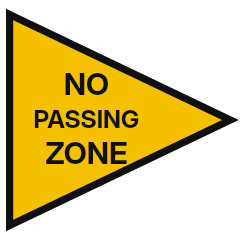
31. Why would a restriction like this one be applied to a stretch of road?
Show answer
Answer A: Because there is not enough visible road ahead to complete a pass safely
Limits on overtaking are set where a hill, a curve or an obstruction leaves too little sight distance for a driver to pull out, pass and return before meeting oncoming traffic.
-
32. You are already leaned over in a curve when you see loose gravel spread across the road ahead. What is the best response?
Show answer
Answer B: Slow gently, bring the bike more upright, and cross the gravel with steady throttle
A leaned tire has little grip left for braking or for loose stones. Reduce speed smoothly, get the motorcycle as upright as the curve allows, and hold a steady throttle across the gravel.
-
33. You are driving on a rural road with no sidewalk. Where should you expect to meet pedestrians?
Show answer
Answer A: Walking toward you on your side of the road
Where there is no sidewalk, pedestrians are taught to walk facing traffic, so they appear on your side of the road coming toward you.
-
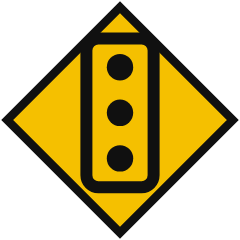
34. Why would this sign be installed on an approach?
Show answer
Answer B: Because the signal cannot be seen from far enough back for a driver to react in time
Advance notice of a signal is used where a crest, a curve, trees or a building keep the signal heads out of view until a driver is already too close to stop comfortably.
-
35. How should a rider use the head and eyes in a turn?
Show answer
Answer A: Turn only the head to look through the turn, keeping the eyes level with the horizon
Turning just the head keeps the upper body from upsetting the motorcycle, and level eyes help the rider judge lean angle and direction.
-
36. Where is a U-turn generally the most reasonable choice?
Show answer
Answer B: At an intersection where it is permitted and you can see well both ways
A U-turn needs a legal place and a long clear view in both directions, which is why a permitted intersection with open sight lines is the usual choice.
-
37. The crossbuck, formed by two rectangular arms crossed in an X, is placed
Show answer
Answer D: on each highway approach to a railroad grade crossing
The crossbuck marks the location of a highway-rail grade crossing and is required on each highway approach to that crossing.
-
38. A bicyclist is riding around a single-lane roundabout in the middle of the lane as you wait to enter. What is your duty?
Show answer
Answer C: Yield to the bicyclist just as you would to a car
A bicyclist using the roundabout is traffic like any other vehicle and has the same claim to the circulating lane.
-
39. A loaded truck is coming up an entrance ramp as you approach in the right lane of the freeway. What is the most helpful action?
Show answer
Answer A: Adjust your speed to open a gap for it
A heavy vehicle accelerates slowly, so opening a gap or moving over costs you seconds and saves the truck driver from being forced to stop on the ramp.
-
40. What should a rider do before riding an unfamiliar or borrowed motorcycle?
Show answer
Answer B: Locate and try the controls, then ride cautiously until used to the machine
Turn signals, horn, headlight switch, fuel valve and engine cut-off switch sit in different places on different models, and hunting for them in traffic is dangerous.
-
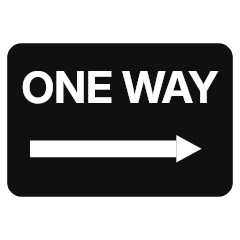
41. A driver on the street this sign governs is preparing to turn left at the next corner. Which lane should the vehicle be in beforehand?
Show answer
Answer A: The lane closest to the left curb
All the traffic here runs the same way, so nothing is coming toward the driver and the turn is taken from the extreme left lane rather than from beside the middle of the roadway.
-
42. Is a windshield an adequate substitute for eye protection?
Show answer
Answer A: No, because air and debris still reach the rider's eyes around and over the screen
Airflow passes over and around a windshield, so a face shield or goggles are still needed to keep the rider's vision clear.
-
43. An emergency vehicle with flashing lights and a siren is approaching from behind on a two-way street. What should you do?
Show answer
Answer C: Pull over to the right edge of the road and stop until it passes
Clearing a path by pulling to the right and stopping gives the emergency vehicle a predictable route, while stopping in mid-lane or inside an intersection blocks that path.
-
44. You are riding at 30 miles an hour and need to move quickly to the left. What do your hands do?
Show answer
Answer D: Press forward on the left handgrip
Above a walking pace a motorcycle turns by leaning, and pressing forward on the grip on the side you want to go is what starts the lean.
-
45. An arrow panel at a work zone displays a flashing arrow pointing to the left. What does it require?
Show answer
Answer C: Move out of the closed lane into the lane on the left
A flashing or sequential arrow on an arrow panel directs traffic out of a closed lane and into the lane the arrow points to.
-
46. You want to turn right at a steady red light and no sign prohibits the turn. What is required?
Show answer
Answer B: Come to a complete stop, then yield to traffic and pedestrians before turning
A right turn on a steady red is permitted only after a complete stop and only after yielding to cross traffic and to pedestrians, and a posted sign can prohibit it entirely.
-
47. A rider adjusts the mirrors and finds each one mostly filled with a view of an elbow. What should be done?
Show answer
Answer D: Readjust them outward so that more of the lane behind becomes visible
Mirrors are useful only for the road behind, and half a mirror filled with the rider is half of an already limited view thrown away.
-
48. Under what road configuration can opposite-direction traffic in Washington pass a stopped school bus with its red lights flashing, even without three or more lanes?
Show answer
Answer B: On a divided highway with physically separate roadways
Washington also excuses opposite-direction traffic from stopping on a divided highway with physically separate roadways for each direction, apart from the separate three-or-more-lane exception.
-
49. Why should a rider avoid riding through a puddle that spans the lane?
Show answer
Answer D: It can hide a deep hole or broken pavement under the surface
Standing water conceals what is underneath it, so treat a puddle as an unknown surface and go around it whenever you safely can.
-
50. You are turning left from a two-way street onto a one-way street. Which lane should you enter?
Show answer
Answer C: The first lane open to traffic on the left side of the one-way street
Turn left from the lane closest to the center line and finish in the first available lane on the left of the one-way street, then change lanes if you need to.