
Washington DOL Motorcycle Practice Test 22
- Questions50
- Correct to pass40
- Passing score80%
- Minimum age16 years
-
1. Why is texting considered one of the most dangerous distractions?
Show answer
Answer B: It combines visual, manual and cognitive distraction at the same time
Reading or writing a message takes your eyes off the road, at least one hand off the controls and your attention off driving simultaneously.
-
2. How does a rider judge whether the brake pads still have life left in them?
Show answer
Answer A: By looking at how much friction material is left on the pad
Pads are inspected visually for remaining thickness against the wear indicator, because a pad worn to its backing plate will destroy the disc.
-
3. Just before the front wheel reaches an obstacle, what should you do with the throttle?
Show answer
Answer C: Roll it on slightly to lighten the front end
A small amount of throttle shifts weight rearward and lightens the front wheel so it rides over the obstacle more easily.
-
4. A pedestrian starts to cross against a Do Not Walk signal, right in front of you. What should you do?
Show answer
Answer D: Slow or stop and let the person reach safety
Even when a pedestrian is crossing unlawfully, a driver must take reasonable care to avoid hitting that person.
-
5. You come around a bend and find loose sand spread across your lane. What should you do?
Show answer
Answer D: Ease off the gas, avoid sudden braking or steering, and keep straight
Loose material acts like ball bearings under the tires; smooth inputs preserve what little grip remains, while sudden braking or steering breaks it.
-
6. What happens if a passenger leans the opposite way to the rider in a curve?
Show answer
Answer B: The motorcycle becomes harder to steer and may run wide in the curve
A passenger leaning against the turn fights the lean angle the rider has set, forcing extra steering effort and pushing the machine toward the outside of the curve.
-
7. The lane you are in has a right-turn-only arrow painted on the pavement. What must you do?
Show answer
Answer C: Turn right, because a lane-use arrow is a legal requirement
Lane-use arrows painted on the pavement are regulatory markings, so a driver in that lane must travel in the direction shown.
-
8. What is the main reason a rider should keep a generous following distance on a rough, broken road?
Show answer
Answer B: So the rider can see and plan for holes and broken pavement in time to react
The vehicle ahead hides the pavement, so extra space gives you time to spot a hole or a broken edge and to choose a path around it.
-
9. A sign showing a walking figure carries a plaque below it with an arrow slanting down to the right. What does the plaque add?
Show answer
Answer B: The crossing is at that very spot
A downward-slanting arrow plaque marks the crossing itself, whereas an AHEAD or distance plaque would place it further along the road.
-
10. At many crossings the walk indication appears only after a button is pressed. What happens if a pedestrian does not press it?
Show answer
Answer B: The signal may cycle without showing a walk indication
An actuated pedestrian phase is called in by the pushbutton, so without it the controller may serve the vehicle movements alone.
-
11. A signal on an entrance ramp changes from red to green and lets one vehicle at a time onto the highway. What should you do?
Show answer
Answer A: Stop on the red and go on the green, one vehicle for each green
A ramp meter spaces vehicles out so they join the highway one at a time instead of arriving as a group, and it is a traffic signal like any other.
-
12. Do hazard lights make it legal to leave your vehicle in a no parking zone?
Show answer
Answer A: No, they warn other drivers but do not permit the parking
Hazard lights are a warning device, not a permit; the parking restriction applies whether they are flashing or not.
-
13. A large truck passes and hits you with a blast of wind. Which lane position leaves you the most room for error?
Show answer
Answer A: The center portion of the lane
A rider in the center portion of the lane has space on both sides to absorb the push of a wind blast without being shoved out of the lane.
-
14. When may a passenger get off the motorcycle?
Show answer
Answer D: Only after the rider has stopped, braced the machine and said so
A passenger climbing off before the rider is ready removes weight from the back of a machine the rider is still holding upright, which can drop it.
-
15. How is the rear brake applied on a standard motorcycle?
Show answer
Answer D: By pressing down a pedal with the right foot
The rear brake pedal is in front of the right footrest and should be pressed down smoothly rather than stamped on.
-
16. When should you move into the lane you need for a turn?
Show answer
Answer D: Well before the intersection, as soon as you know your route
Getting into the correct lane early lets other drivers read your intentions and keeps you from making a sudden lane change at the corner.
-
17. You are approaching a blind right hand curve. Which starting lane position gives the best view through it?
Show answer
Answer C: The left portion of the lane, toward the outside of the curve
Starting at the outside of a curve opens up the line of sight through it, and the rider then moves toward the inside as the exit comes into view.
-
18. Where is moped operation prohibited under Washington law?
Show answer
Answer D: On a fully controlled limited access highway or a sidewalk
Washington law prohibits operating a moped on a fully controlled limited access highway or on a sidewalk.
-
19. A driver behind you on a two-lane road clearly wants to pass. Why should you not wave that driver past?
Show answer
Answer B: You cannot see the whole road ahead for them and they may rely on your signal
Waving another driver out invites them to trust your judgment of a road you cannot see well enough, and the decision to pass belongs to the driver making it.
-
20. Your route crosses a long steel grid bridge deck. What should you do about braking and speed while you are on the grating?
Show answer
Answer B: Keep a steady speed and do any braking before the grating, not on it
A steel deck makes the motorcycle weave and offers less grip, so set your speed before you reach it, ride straight across, and brake on solid pavement.
-
21. What should a passenger do when the motorcycle leans into a curve?
Show answer
Answer A: Lean with the operator, staying directly behind them
A passenger who leans with the operator lets the motorcycle follow its natural line, while leaning against the lean fights the operator's control inputs.
-
22. What is the right speed for a normal right turn at a city corner?
Show answer
Answer C: Slow enough to hold your lane and stop for a pedestrian
A city right turn is tight and crosses a crosswalk, so the correct speed is one that keeps you inside your lane and still allows a stop.
-
23. Under Washington's habitual offender law, how are multiple traffic offenses committed within six hours of each other counted on a first occurrence?
Show answer
Answer B: They are treated as a single offense on that first occasion
Washington's habitual offender statute treats multiple offenses committed within a six-hour period as one offense the first time this happens.
-
24. A line of short dashes set closer together than an ordinary lane line runs beside your lane where a ramp leaves the highway. What does a dotted line of that kind convey?
Show answer
Answer A: A warning that the lane is about to change function
Dotted lines give guidance or warning about a downstream change, such as a lane that becomes an exit only lane or a lane line carried across an intersection.
-
25. A bag strapped to the back of your motorcycle works loose and starts to shift as you ride. What should you do?
Show answer
Answer C: Slow smoothly, pull off the road, and secure the load before riding on
A load that moves changes the balance of the motorcycle and can foul a wheel or the chain, so stop as soon as you safely can and fasten it properly.
-
26. From which lane should a permitted U-turn be started?
Show answer
Answer A: The lane nearest the center line, the same one used for a left turn
A U-turn is begun from the far left lane for your direction, the same position used for a left turn, so you do not cut across traffic beside you.
-
27. You feel dizzy, weak and clammy after an hour of riding in high heat. What should you do?
Show answer
Answer B: Stop in the shade, drink water and cool down before riding further
Those are early signs of heat illness and they get worse with continued exertion, so get out of the sun, rehydrate and cool off before you ride on.
-
28. Why should the leader of a group check the mirrors regularly?
Show answer
Answer B: To see whether the group is still together and adjust the pace if not
The leader is the only rider who can see the whole formation, and slowing slightly is the usual way to gather a group that has strung out.
-
29. You are about to carry a passenger for the first time. Where should you begin?
Show answer
Answer C: In a quiet area away from traffic, at low speed
A passenger changes balance, braking and steering feel, and those differences are best learned somewhere there is nothing else to deal with.
-
30. In heavy fog at night on a rural two-lane road, which marking best helps a driver hold position?
Show answer
Answer C: The solid white line along the right edge
Steering by the right edge line keeps a driver clear of oncoming traffic, while watching the center line tends to pull the vehicle toward it.
-
31. You reach a four-way stop after another driver has already stopped there. What should you do?
Show answer
Answer D: Let the driver who stopped first proceed before you go
At a four-way stop the vehicles proceed in the order they arrived, so a driver who stopped before you goes first.
-
32. You are backing out of a space in a parking lot. Who has the right of way?
Show answer
Answer D: Traffic already moving in the lane, and pedestrians walking behind you
A driver backing out must yield to vehicles and pedestrians already using the lane, because backing is the movement with the poorest view.
-
33. At an intersection the signal flashes red toward you and flashes yellow toward the cross street. Who must yield?
Show answer
Answer D: You must, because the flashing red faces your road
A flashing red means stop and yield like a stop sign, while a flashing yellow lets the other road proceed with caution.
-
34. A deer crosses the road ahead of you and disappears into the trees. What should you expect?
Show answer
Answer A: More animals may follow, since deer usually move in groups
Deer commonly travel in groups, so one animal crossing is a warning that others are close by. Slow down and stay ready to stop well past the point where it crossed.
-
35. A small signal face beside a bikeway shows red, yellow and green lenses that each carry a bicycle symbol. Whom does it control?
Show answer
Answer C: Bicyclists using that crossing or bikeway
A bicycle signal face governs bicycle movements only, and people on foot at the same corner still follow the pedestrian signal.
-
36. What does it mean to scan the road while driving?
Show answer
Answer A: Moving your eyes constantly over the road, the sides and the mirrors
Scanning keeps information coming in from every direction, while a fixed stare leaves you blind to everything else.
-
37. The rider who was behind you has vanished from your mirrors. What should you do?
Show answer
Answer C: Ease off and pass the word forward so the group can respond
A rider missing from the line may have stopped or had trouble, and the group needs to know at once so it can slow down or pull over safely.
-
38. What does Washington require of a rider under 18 before applying for a motorcycle endorsement?
Show answer
Answer D: Satisfactory completion of an approved safety course, plus parental permission
Washington law requires all riders under 18 to satisfactorily complete an approved safety course before applying for an endorsement, and students under 18 need parental permission to take the course and apply.
-
39. A bike lane on your right is marked with a dashed line for the last stretch before the corner. What does that dashed section allow you to do?
Show answer
Answer D: Merge into the bike lane after checking, and turn right from there
The dashed section is where drivers are meant to merge into the bike lane before turning, which puts cyclists behind the vehicle instead of beside it.
-
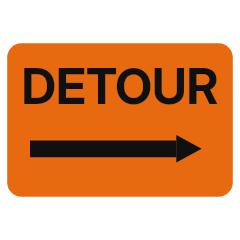
40. Once a driver has joined the route this sign begins, how is the rest of the way marked?
Show answer
Answer B: By further markers of the same kind at each turn, until the original road is rejoined
The alternate route is signed continuously, with a marker at every turn, so a driver with no local knowledge can follow it back to the original road.
-
41. You are leaving a private driveway and entering a public street. What are you required to do?
Show answer
Answer B: Stop and yield to traffic on the street and to pedestrians on the sidewalk
A driver entering a roadway from a driveway, alley or private road must stop and yield to traffic on the roadway and to pedestrians on the sidewalk being crossed.
-
42. You are overtaking in a short passing lane on a two-lane road and it is about to end. What must you do?
Show answer
Answer A: Finish the pass and move back to the right before it ends
The added lane ends and the traffic returns to a single lane in each direction, so the pass has to be complete before the pavement runs out.
-
43. A yellow sign ahead of an underpass reads LOW CLEARANCE 12 FT 6 IN. What does the figure tell you?
Show answer
Answer B: The greatest height that can pass beneath the structure
The figure is the actual clearance available, so a vehicle taller than that must leave the road and take a marked alternative route.
-
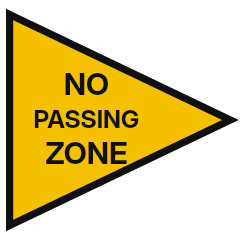
44. Where does the restriction that starts at this sign come to an end?
Show answer
Answer D: Where the centerline markings show that overtaking is allowed again
The sign marks the start of the restricted section, and the centerline markings along the road show how far it runs and where overtaking becomes lawful again.
-
45. You have just driven through a deep puddle and your brakes feel weak. What should you do?
Show answer
Answer D: Drive slowly while lightly applying the brakes until they dry and work normally
Wet brakes grip poorly and may pull to one side. Gentle braking at low speed generates heat that dries the pads and discs quickly.
-
46. A pedestrian is waiting to cross ahead of you and you have slowed down. What helps most?
Show answer
Answer D: Making eye contact, so that you both know you have seen each other
Eye contact confirms that you have seen each other; waving someone across can send them into the path of another vehicle.
-
47. On a long drive you notice repeated yawning, missed exits and drifting toward the lane line. What should you do?
Show answer
Answer C: Pull off at a safe place and sleep, or change drivers
Those are warning signs that sleepiness is already interfering with driving, and only rest restores alertness. Fresh air, music and caffeine do not reverse it.
-
48. Is it a good idea to shift into neutral and coast down a long hill to save fuel?
Show answer
Answer B: No, you lose engine braking and some control of the vehicle
In neutral the engine cannot help slow the vehicle, so the brakes do all the work and can overheat. Stay in gear so the drivetrain helps hold your speed.
-
49. What is the PRIME position on a fuel supply valve used for?
Show answer
Answer D: To let fuel flow into the carburetor after the machine has stood unused
PRIME bypasses the normal vacuum control and lets fuel refill an empty carburetor, which helps a machine start after sitting for a long time.
-
50. When are you expected to switch from high beams to low beams?
Show answer
Answer D: When a vehicle approaches from ahead or you come up behind another vehicle
High beams blind other drivers, both those coming toward you and those you follow through their mirrors. Dim them whenever another vehicle is within range.