
Washington DOL Motorcycle Practice Test 10
- Questions50
- Correct to pass40
- Passing score80%
- Minimum age16 years
-
1. Two people drink the same amount of alcohol at the same time. Why might their blood alcohol concentrations differ?
Show answer
Answer C: Body weight, gender and food in the stomach affect the concentration
Smaller people and, on average, women reach higher concentrations from the same amount of alcohol, and an empty stomach speeds absorption. Counting drinks alone does not tell you your level.
-
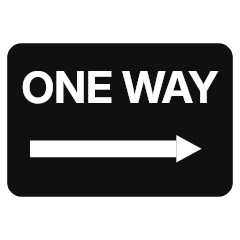
2. A driver disregards this sign and turns so as to travel against the direction it establishes. What is the immediate danger?
Show answer
Answer D: The driver will face traffic head on, because every lane comes the other way
Turning against the established direction puts the vehicle nose to nose with all the traffic on that street, which is why the mistake has to be corrected at once.
-
3. A large panel mounted on a trailer at the roadside displays a flashing arrow pointing left. What does it tell you?
Show answer
Answer B: Move into the lane to your left
An arrow panel directs traffic out of a closed lane, so the arrow shows the direction you must move rather than the shape of the road ahead.
-
4. Where does a rider find the correct chain slack figure for a particular motorcycle?
Show answer
Answer B: In the owner manual for that motorcycle
Correct slack varies from model to model, so the manufacturer specification in the owner manual is the only reliable figure.
-
5. In a work zone a flagger is directing traffic in a way that conflicts with the posted signs. Whom do you follow?
Show answer
Answer B: The flagger's directions
A flagger controls traffic through a work area that changes from day to day, and those instructions take precedence over the fixed signs and markings in that zone.
-
6. What is lane splitting?
Show answer
Answer B: A motorcycle riding between two lanes of traffic moving the same way
Lane splitting means riding along the line between two lanes of traffic going in the same direction rather than staying within a lane.
-
7. How does Washington law classify a violation of the ban on holding a personal electronic device while driving?
Show answer
Answer D: A traffic infraction
Washington classifies a violation of the personal electronic device ban as a traffic infraction, not a criminal offense.
-
8. On dry pavement in good weather, what is the smallest following gap you should keep?
Show answer
Answer A: About three seconds behind the vehicle ahead
Three seconds is the accepted minimum on dry roads in good visibility, and the gap should be longer in poor conditions.
-
9. Why can an oncoming vehicle that looks comfortably far away leave you far less room than you expect?
Show answer
Answer D: You and that vehicle close the gap at the sum of both your speeds
Two vehicles approaching at 55 mph each close the distance between them at about 110 mph, so the gap disappears in half the time you would expect.
-
10. How many usable riding paths does a single traffic lane offer a motorcycle?
Show answer
Answer C: Three
A lane is normally treated as a left, center and right path, and the rider picks the one that gives the best visibility and the largest space cushion.
-
11. Rain is falling and the outside temperature reads close to 32 degrees Fahrenheit. Why is that dangerous?
Show answer
Answer A: The rain can freeze on contact and glaze the road with ice
Near freezing, rain landing on cold pavement can turn to a glaze of ice almost at once, so a road that looks merely wet may have no grip at all.
-
12. A regulatory sign posted at the start of a road reads LENGTH LIMIT 30 FEET. What does it control?
Show answer
Answer B: The overall length of vehicle allowed on that road
Some states post a length limit where tight curves or narrow structures lie ahead; it bars vehicles or combinations longer than the figure shown from using that road.
-
13. A yellow sign reads SOFT SHOULDER. What is it telling you?
Show answer
Answer C: The shoulder may not carry the weight of a vehicle
A soft shoulder is unpaved and can let a wheel sink, so a driver who leaves the pavement there may lose control or become stuck.
-
14. You approach a traffic signal that has already been green since it first came into view. What should you expect?
Show answer
Answer B: That it may change at any moment, so be ready to stop
A signal already green when you first see it is well into its cycle, so a rider covers the brakes and plans a stop rather than assuming a clear run.
-
15. A rider in the middle of the group pulls over onto the shoulder. What should the sweep rider do?
Show answer
Answer C: Stop and stay with that rider while the rest of the group continues
The sweep exists so that no rider is ever left alone at the roadside, while the remainder of the group carries on to a safe place to wait.
-
16. Which headlight setting should you use in dense fog?
Show answer
Answer B: Low beams
High beams reflect off the water droplets in fog and bounce glare back at you, while low beams aim downward and light the road without that mirror effect.
-
17. A hands free phone conversation is which kind of distraction?
Show answer
Answer C: Cognitive, because your mind leaves the road
Hands free equipment removes the manual and visual parts of a call but not the mental load, and it is the mental load that makes a driver miss hazards.
-
18. Compared with dry pavement, how much room does a vehicle need to stop on packed snow?
Show answer
Answer D: Several times as much
Grip on packed snow is a fraction of that on dry pavement, so stopping distance grows several times over. Antilock brakes help you steer, not stop shorter.
-
19. In the code that governs pavement markings, what does a double line stand for?
Show answer
Answer B: A maximum restriction
The marking code is consistent: a double line means the strongest restriction, a solid line discourages or forbids crossing, and a broken line is permissive.
-
20. Which clue suggests that a car waiting at a side street is about to pull out in front of you?
Show answer
Answer B: The front wheels are turned and the car is creeping forward
Turned wheels and a slow creep forward are the strongest signs that a driver is about to move, so cover the brakes and be ready to change your lane position.
-
21. You are leaving a freeway at an exit that has a deceleration lane. Where should you slow down?
Show answer
Answer C: After you have moved fully into the exit lane
Braking in a through lane surprises the traffic behind you, so you move into the exit lane at highway speed and then slow down inside it.
-
22. How do worn tires and worn brakes affect your ability to stop?
Show answer
Answer C: They lengthen the stopping distance, especially on a wet road
Worn tread cannot clear water and worn brakes cannot produce full force, so both stretch the distance needed to stop.
-
23. You are turning left from a one-way street onto a two-way street. How should the turn be made?
Show answer
Answer B: Start in the far left lane and finish just to the right of the center line
Left turns begin from the lane nearest the left edge of the street you are leaving and must finish on the right-hand side of the center line of a two-way street.
-
24. A friend wants a ride, but their feet do not reach the passenger footrests. What should you do?
Show answer
Answer A: Do not carry them, since they cannot hold a stable position
A passenger who cannot plant both feet on the footrests cannot brace or stay in place, and dangling legs can reach the chain, the exhaust or the wheel.
-
25. A crash happens directly in front of you and vehicles are blocking both lanes. What should you do?
Show answer
Answer B: Stop at a safe distance, put on the hazards and warn the traffic behind
The greatest danger after a crash is a second collision, so stop short of it and make sure the traffic behind you can see the problem.
-
26. You are wearing a high visibility jacket. How should that change the way you ride?
Show answer
Answer B: You still ride as though drivers have not seen you
Bright gear improves your odds of being noticed but guarantees nothing, so keep the lane position, space cushion and escape routes that protect you anyway.
-
27. What does a marked crosswalk tell a driver approaching a corner?
Show answer
Answer D: Where pedestrians are expected to cross and must be given way
Crosswalk markings show pedestrians where to cross and warn drivers to yield to anyone using the crossing.
-
28. A stop sign at a busy corner has a stop line and a crosswalk, but buildings block your view of the cross street. What is the correct sequence?
Show answer
Answer C: Stop at the line first, then edge forward and stop again to see
The first stop is required at the line or before the crosswalk, and a second stop farther forward is what actually lets you yield safely.
-
29. What should a rider look for in rain gear?
Show answer
Answer A: A riding rain suit that fits close and will not balloon or tear at speed
Rain gear designed for riding stays sealed and stays put in the airstream, while loose garments can flap, tear or interfere with the controls.
-
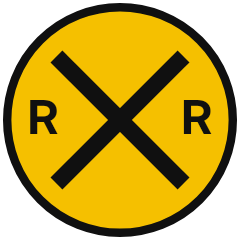
30. A driver sees this sign on a quiet road with no other traffic in either direction. What is the correct response?
Show answer
Answer C: Slow down, look and listen for a train, and be ready to stop
The sign gives advance notice of a highway-rail grade crossing, so the driver reduces speed, checks both directions along the tracks and keeps enough room to stop short of the rails.
-
31. What is the main source of the noise that damages a rider's hearing?
Show answer
Answer A: Wind turbulence around the helmet, which rises sharply with speed
Wind noise around a helmet is loud enough at highway speed to cause permanent hearing loss over time, which is why earplugs are recommended even on quiet machines.
-
32. Can a Washington court waive, reduce or suspend the fine for a move-over law violation?
Show answer
Answer D: No, the fine may not be waived, reduced or suspended
Washington law prohibits waiving, reducing or suspending the fine for a move-over law violation.
-
33. You are following a car at night with the high beam on. What should you do?
Show answer
Answer C: Switch to the low beam so the driver ahead is not blinded
A high beam fills the mirrors of the vehicle ahead and blinds its driver, which is dangerous for the very driver most able to affect the rider.
-
34. An orange background with a black legend on a sign indicates
Show answer
Answer B: a temporary traffic control or work zone situation
Orange is reserved for temporary traffic control signing, so an orange sign means conditions have been altered for work or another temporary operation.
-
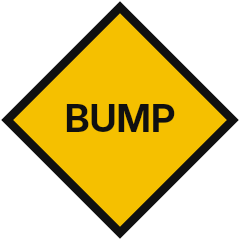
35. How should a driver respond to this sign?
Show answer
Answer C: Slow down before reaching the rough spot and cross it at a steady, low speed
Losing speed before a sharp rise in the pavement keeps the vehicle settled, while braking or accelerating on top of it unsettles the suspension and costs grip.
-
36. You have a green left-turn arrow but a pedestrian is still walking in the crosswalk you must cross. What should you do?
Show answer
Answer B: Wait until the crosswalk is clear before turning
A green arrow protects you from other vehicles, but it never removes the duty to yield to a person already in the crosswalk.
-
37. You have just passed a large truck on the freeway. Why is it dangerous to pull back in front of it and then brake for your exit?
Show answer
Answer B: A loaded truck needs much more distance to stop than a car
A fully loaded tractor-trailer can need the length of a football field or more to stop from highway speed. Cutting in and braking leaves the driver no room to avoid hitting you.
-
38. Oil is visible running down the front fork tubes. What does that mean?
Show answer
Answer C: A fork seal has failed and the suspension needs repair
Fork oil escaping past a seal means the front suspension is losing its damping, and the oil can also reach the front brake and ruin its grip.
-
39. The signal turns green as you approach an intersection. What is the safest practice?
Show answer
Answer B: Look left, then right, then left again, and make sure the intersection is clear before entering
A green light gives permission but does not guarantee the intersection is empty, and a quick scan catches a vehicle running the red or a pedestrian still crossing.
-
40. Where should a passenger sit on the motorcycle?
Show answer
Answer A: As far forward as possible without crowding the operator
Sitting well forward keeps the passenger weight close to the center of the motorcycle, which helps it handle closer to normal.
-
41. A shared-use path crosses the road ahead at a marked crossing and people are already crossing on it. What should you do?
Show answer
Answer C: Yield and let them finish crossing the road
People already crossing at a marked crossing have the right of way, and a path crossing is a crossing of the roadway like any other.
-
42. How does the distance needed to stop change when a rider doubles speed?
Show answer
Answer D: It grows to roughly four times the original distance
Braking distance rises with the square of speed, so twice the speed needs roughly four times the distance in which to stop.
-
43. A center lane is marked with a broken yellow line on each side and is controlled by overhead lane signals. How is that lane used?
Show answer
Answer A: It carries traffic one way or the other according to the signals
A reversible lane is marked with broken yellow lines on both sides and its direction of travel is set by the lane control signals above it.
-
44. How does driving on overinflated tires affect the vehicle?
Show answer
Answer D: It gives a harsher ride and a smaller contact patch
An overinflated tire bulges in the middle, so less rubber touches the road, grip suffers and the ride becomes hard. The center of the tread wears first.
-
45. While you wait for the ambulance at a crash, what is the most useful help you can give?
Show answer
Answer C: Keep the person still and warm, and press down firmly on any heavy bleeding
Keeping an injured person still and warm and controlling bleeding are among the few things a bystander can safely do.
-
46. A line beside your lane is painted about twice the normal width. What does the extra width convey?
Show answer
Answer B: Greater emphasis on the restriction it carries
Width is part of the marking code: a wide line carries more emphasis than a normal one, which is why it is used at gores and channelizing lines.
-
47. The leader of a group wants to pull the whole group out from a side road into busy traffic. What should the leader do?
Show answer
Answer B: Wait for a gap long enough for every rider in the group to enter
A leader who takes a gap that only fits one machine leaves the rest of the group either stranded or tempted to pull out in front of traffic.
-
48. What is the safest way to deal with a vehicle sitting in your blind spot?
Show answer
Answer A: Slow a little or move ahead so that it is no longer beside you
You cannot control the other driver, but you can change your own speed so that the vehicle is no longer hidden beside you.
-
49. A traffic light ahead of the group turns yellow as the leader approaches it. What should the leader do?
Show answer
Answer C: Stop normally and let the group be split by the signal
Keeping the group together never outranks obeying the signal, and the riders left behind simply catch up at the next stop.
-
50. A driver waiting to turn left appears to be looking straight at you. What should you assume?
Show answer
Answer C: That the driver may still not have seen you, and may turn across your path
Drivers look toward motorcycles without registering them, so eye contact is not evidence that the rider has been seen and no plan should depend on it.