
Washington DOL Permit Practice Test 32
- Questions40
- Correct to pass32
- Passing score80%
- Minimum age15 years
-
1. Which of these is never a legal place to park?
Show answer
Answer C: In a crosswalk, on a sidewalk or within an intersection
Crosswalks, sidewalks and intersections must stay clear so that pedestrians can cross and drivers can see approaching traffic.
-
2. A yellow curve warning sign carries a yellow plaque showing a speed. What does that number mean?
Show answer
Answer D: The recommended maximum safe speed for the curve under ideal conditions
An advisory speed plaque on a yellow warning sign gives the recommended maximum speed for the hazard ahead when conditions are good.
-
3. On a Washington roadway with four or more lanes, what does the move-over law require when a qualifying emergency or work zone vehicle is stopped ahead?
Show answer
Answer A: Change lanes away from the vehicle, or slow down if unsafe
On a roadway with four or more lanes, Washington's move-over law requires changing lanes away from the qualifying vehicle, or slowing down if a lane change is not safe.
-
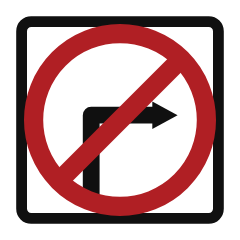
4. A driver stopped at a red signal wants to turn right and this sign is posted at the corner. What is permitted?
Show answer
Answer A: Nothing: the turn is barred whether the signal is red or green
The restriction works independently of the signal, so the usual permission to turn right after stopping at a red light does not exist where this sign is posted.
-
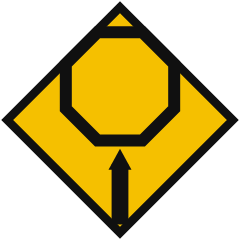
5. What is the driver expected to do after passing this sign?
Show answer
Answer A: Begin slowing so that a complete stop can be made at the intersection ahead
It is used where the control at the intersection stays hidden until late, so braking should begin here rather than at the stop line.
-
6. You are already inside an intersection when you realize you should be in the lane beside you. What should you do?
Show answer
Answer C: Stay in your lane through the intersection and change lanes afterwards
Drivers in an intersection are watching for cross traffic and turning vehicles, so an unexpected sideways move there is easily missed.
-
7. At a stop sign with a painted stop line and a crosswalk, where must you stop?
Show answer
Answer D: At the stop line, before it and before the crosswalk
You stop at the stop line first, and only if there is no stop line do you stop before the crosswalk, and only if there is neither do you stop before entering the intersection.
-
8. You brake hard in a vehicle with antilock brakes and feel the pedal pulsing under your foot. What should you do?
Show answer
Answer A: Keep firm, steady pressure on the pedal and steer where you need to go
The pulsing is the system releasing and reapplying the brakes so the wheels keep rolling, which is what lets you steer while braking. Pumping the pedal defeats it.
-
9. How can a Washington intermediate license holder gain unrestricted hours and passenger limits before turning 18?
Show answer
Answer C: By keeping a clean record for 12 months after licensing
Washington lets an intermediate license holder drive without the usual hour and passenger restrictions after 12 months with no violations or at-fault accidents.
-
10. You must cross a stretch of water lying across the road that you know is shallow. What is the right technique?
Show answer
Answer A: Slow down before you reach it and cross steadily in a low gear
Slow before the water, then keep a steady low speed so you do not throw water over the engine or lose steering. Test the brakes gently once you are through.
-
11. Where is the safest place for children under 13 to ride?
Show answer
Answer C: In the back seat
The back seat keeps children away from the force of a deploying front air bag and is farther from the most common impact area, which is why it is recommended through at least age 12.
-
12. A driver extends the left arm out the window and points it downward toward the road surface. What is being signaled?
Show answer
Answer A: Slowing down or stopping
The left arm extended downward is the standard hand signal for slowing or stopping.
-
13. You realize you have turned the wrong way onto a one-way street. What should you do?
Show answer
Answer A: Pull to the right, stop, and back into the street you came from when clear
Get out of the traffic stream first: pull right and stop, then back out into the street you came from once you can see it is safe.
-
14. A bicyclist is riding around a single-lane roundabout in the middle of the lane as you wait to enter. What is your duty?
Show answer
Answer C: Yield to the bicyclist just as you would to a car
A bicyclist using the roundabout is traffic like any other vehicle and has the same claim to the circulating lane.
-
15. An orange background with a black legend on a sign indicates
Show answer
Answer B: a temporary traffic control or work zone situation
Orange is reserved for temporary traffic control signing, so an orange sign means conditions have been altered for work or another temporary operation.
-
16. You are driving along a street lined with parked cars. What should you watch for?
Show answer
Answer B: Doors opening, vehicles pulling out and pedestrians stepping from between cars
Parked cars hide people and can move without warning. Keep as much space from them as you safely can and cover the brake.
-
17. A deer crosses the road in front of you and disappears into the trees. What should you expect?
Show answer
Answer B: That other deer are likely to follow it across the very same stretch of road
Deer usually move in groups, so one crossing the road is a warning that more may follow.
-
18. What happens when alcohol is combined with another drug that also affects the nervous system?
Show answer
Answer B: Impairment is often far greater than either one alone would produce
Combined substances can multiply each other's effects, producing impairment well beyond what a driver would expect from either one taken separately.
-
19. In which crash must the police always be notified?
Show answer
Answer D: Any crash in which somebody has been injured or killed, whatever the damage
Injury or death always makes a crash reportable, whatever the amount of vehicle damage or the opinions of the drivers.
-
20. The traffic signal is green, but the crossing lights on the tracks inside the intersection begin to flash. What must you do?
Show answer
Answer C: Stop clear of the tracks and wait, even though the signal is green
Active crossing warning devices outrank the green indication, so you stop short of the rails and wait until the warning stops.
-
21. How can a Washington driver legally use studded tires outside the November 1 to April 1 window?
Show answer
Answer D: With studs that retract and are engaged only during the allowed season
Washington allows tires with studs that retract below the tread to be used year-round, as long as the studs are engaged only during the allowed November 1 to April 1 season.
-
22. You are passing a crash on the other side of a divided highway. What should you do?
Show answer
Answer D: Keep your eyes on your own lane and the traffic around you
Staring at a crash scene, often called rubbernecking, causes sudden slowing and secondary collisions. Your attention belongs on the traffic in front of you.
-
23. A bus stopped at the corner hides the crosswalk you are about to turn across. What should you do?
Show answer
Answer C: Turn slowly, ready to stop for anyone stepping out in front of it
People often step into the road from in front of a stopped bus, so approach the hidden crosswalk slowly and be ready to stop.
-
24. You and a driver coming from the opposite direction reach a four-way stop at the same time and you are both going straight ahead. What happens next?
Show answer
Answer D: Both of you may move off together, because your paths do not cross each other
Opposing vehicles that are both going straight do not cross paths, so they can move off together once the intersection is clear.
-
25. What most often starts a rear wheel skid?
Show answer
Answer A: Too much speed, braking or acceleration for the grip available
A skid begins when what you ask of the tires exceeds what the surface can give, which is usually a matter of speed and of how abruptly you use the controls.
-
26. What actually lowers the amount of alcohol in a person's blood?
Show answer
Answer D: The passage of time
The body eliminates alcohol at its own steady rate, so only time reduces blood alcohol. Coffee or a cold shower may make a person feel more awake while still impaired.
-
27. Two solid white lines separate your lane from the lane beside it. What do they mean?
Show answer
Answer B: Crossing from one lane to the other is prohibited
A solid double white line marks a boundary that road users may not cross, such as the entrance to a preferential lane.
-
28. You and an oncoming driver are both turning left at the same intersection. What is the usual rule?
Show answer
Answer D: Both turn in front of each other unless markings show otherwise
The normal practice is to pass driver side to driver side, turning in front of one another, unless pavement markings or signs direct a different path.
-
29. What should you do with the key and your belongings when you leave the vehicle in a public lot?
Show answer
Answer D: Take the key with you, lock up and put valuables out of sight
Most vehicle thefts are opportunistic: a key left behind or a bag in plain view is the invitation.
-
30. On a long, straight highway you feel your attention fading. What helps you stay alert?
Show answer
Answer A: Keep your eyes moving, scan mirrors and signs, and take regular breaks
Staring at one point brings on highway hypnosis. Active scanning keeps the mind engaged, and a break every couple of hours restores alertness.
-
31. Why should the shoulder belt never be worn under the arm or behind the back?
Show answer
Answer C: In a crash it could not hold your upper body and could cause severe injury
The shoulder belt restrains your chest and head. Placed under the arm it concentrates crash force on the ribs and organs; behind the back it does nothing at all.
-
32. May you exceed the posted speed limit in order to complete a pass?
Show answer
Answer C: No, the posted limit applies while you are passing too
The limit does not lift for passing; if you cannot complete the pass within it, there is not enough room and you should stay back.
-
33. Absent any other posted limit, what speed does Washington law set as the maximum on city and town streets?
Show answer
Answer A: 25 miles per hour
Washington's basic speed statute sets 25 miles per hour as the default maximum on city and town streets when no other limit is posted.
-
34. Which ability does alcohol usually affect first?
Show answer
Answer A: Judgment and self control
Alcohol reduces judgment and inhibition before a drinker notices any clumsiness, which is why an impaired driver often feels perfectly capable while already driving worse.
-
35. You are driving in the left lane at the posted speed limit and a line of vehicles has built up behind you. What should you do?
Show answer
Answer D: Move into a lane on your right when it is safe and let the traffic behind go by
Most states require traffic moving slower than the flow to keep right and reserve the left lane for passing, so a driver holding up a line of vehicles should move right when it is safe rather than block the lane.
-
36. Alcohol is classified as which kind of drug?
Show answer
Answer B: A depressant that slows the central nervous system
As a depressant, alcohol slows the brain and nervous system, which lengthens reaction time and dulls the coordination that driving depends on.
-
37. You have finished a distracting task and your eyes are back on the road. What is true?
Show answer
Answer A: Your full attention takes a while to come back
Studies of drivers show attention lags behind the eyes for many seconds after a phone or a screen task, so the danger continues after the task is over.
-
38. You have just been involved in a crash on a city street. Which sequence of first steps is correct?
Show answer
Answer A: Stop where you are, check everyone for injuries, and then make the scene safe
You are required to stop, and the first priority at the scene is people, followed by preventing a second collision.
-
39. Your light is green but the traffic beyond the intersection is stopped and there is no room on the far side. What should you do?
Show answer
Answer A: Wait behind the line until you can clear the far side
Entering an intersection you cannot clear blocks the cross traffic when their signal turns green, so you wait behind the line.
-
40. You are behind three slow vehicles on a two-lane road and the way ahead looks clear. What is the sound decision?
Show answer
Answer D: Pass one vehicle at a time, if the road allows it
Passing several vehicles in one move keeps you in the oncoming lane far too long and leaves nowhere to go if a vehicle appears.