
Washington DOL Permit Practice Test 23
- Questions40
- Correct to pass32
- Passing score80%
- Minimum age15 years
-
1. A large truck is passing you on a two-lane road. What is the safest thing to do?
Show answer
Answer C: Keep right in your lane and ease off the gas a little
Staying in your own lane and easing off shortens the pass without forcing you onto a soft shoulder or into the truck's path.
-
2. Your vehicle has a backup camera. What is the right way to use it?
Show answer
Answer C: Use it as an aid, but still turn and look behind you
A camera has a limited field of view and can be dirty or wet, so it supplements looking over your shoulder and using the mirrors rather than replacing them.
-
3. When is a driver or rider most likely to need hand and arm signals instead of the vehicle turn signal lamps?
Show answer
Answer D: When the lamps have failed or cannot be seen because of glare or a load
Hand and arm signals replace or reinforce the lamps whenever the lamps do not work or cannot be seen clearly by other road users.
-
4. The lane you are in is marked with a straight arrow and a right-turn arrow together. What does that mean?
Show answer
Answer D: Drivers in that lane may either go straight or turn right
A lane marked with two arrows serves both movements, so a driver in it may take either one.
-
5. Why should you set the parking brake even when an automatic transmission is in Park?
Show answer
Answer B: Because it takes the strain off the transmission and holds the vehicle
The parking pawl is a small part carrying the whole vehicle; the parking brake shares that load and holds the vehicle if the pawl fails.
-
6. A driver stopped on suspicion of impaired driving refuses to take a chemical test. What happens?
Show answer
Answer D: A license penalty follows for the refusal itself
Under implied consent, holding a license means agreeing to testing, so a refusal brings its own suspension separately from anything the court decides.
-
7. You are parked legally, but a police officer tells you to move the vehicle. What should you do?
Show answer
Answer B: Move it as directed, because an officer overrides the signs
Directions from a police officer or a firefighter take precedence over signs and markings, whether they are directing traffic or clearing a street.
-
8. What should you avoid when a hostile driver pulls alongside you?
Show answer
Answer A: Making eye contact, or answering the gestures in any way at all
Any response, including a look, encourages an aggressive driver, so give none and let the vehicle go.
-
9. You are driving on an open highway in a strong crosswind. What is the safest adjustment?
Show answer
Answer A: Reduce speed and keep a firm grip, expecting gusts on bridges and beside large vehicles
Gusts hit hardest in open gaps, on bridges and when passing high-sided vehicles, so a lower speed and a firm grip let you correct before you are pushed out of your lane.
-
10. On a busy multilane highway, where is the best place to travel?
Show answer
Answer B: In a gap in the traffic, with space open on both sides
Travelling in a gap keeps escape routes open on both sides, while riding alongside other vehicles removes the room you would need to swerve.
-
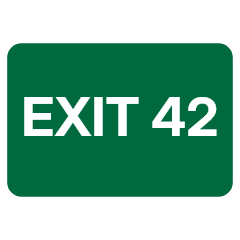
11. Where is signing of this kind normally placed along a freeway?
Show answer
Answer D: Ahead of the interchange and again at the exit, so a driver can reach the correct lane in time
Guide information for an interchange is repeated on the approach and at the ramp, because a driver who learns about the exit only at the last moment has no room left for a safe lane change.
-
12. Why is standing water across a road dangerous even when it looks shallow?
Show answer
Answer B: It can hide a washed out roadbed, a deep hole or a missing cover
You cannot see the surface under the water, and floods commonly wash the roadbed away or lift covers off drains.
-
13. Why must you never leave the engine running in a closed garage?
Show answer
Answer B: Because carbon monoxide builds up and can kill within minutes
Exhaust gas contains carbon monoxide, which has no smell or color and can reach fatal levels in an enclosed space very quickly.
-
14. What happens when tires are driven underinflated for a long time?
Show answer
Answer D: They wear at the edges, they run hot and they are more likely to fail
An underinflated tire flexes too much, which wears the shoulders and builds up heat that can destroy the tire.
-
15. A police officer in the intersection raises a hand toward you although your signal is green. What should you do?
Show answer
Answer B: Stop and wait for the officer to wave you on
An officer directing traffic overrides signals and signs, and drivers must follow the officer even when the light says otherwise.
-
16. You are in the open lane where another lane is merging into yours. What is your part in the merge?
Show answer
Answer A: Keep a steady speed and leave a gap for one vehicle to come in
A merge works when each driver in the through lane lets one vehicle in, which keeps both lines moving instead of stopping them both.
-
17. You are towing a loaded trailer for the first time. How should you drive?
Show answer
Answer A: Slow earlier and keep a longer following gap
A trailer adds weight and length, so stopping takes longer and every maneuver needs more room and more warning.
-
18. When should headlights be switched on besides during the hours of darkness?
Show answer
Answer C: Whenever rain, fog, snow or dust makes it harder to see or to be seen
Headlights are as much about being seen as about seeing, so they go on whenever visibility drops.
-
19. A person in a wheelchair is traveling in the roadway because the sidewalk is blocked by construction. What should you do?
Show answer
Answer B: Pass slowly with plenty of room, or wait
A blocked sidewalk leaves the person no choice but the road, and a chair cannot move aside quickly, so pass wide and slow or wait for room.
-
20. Crossing a parking lot on a hot day, you see a young child alone in a locked car. What should you do?
Show answer
Answer A: Call 911 right away and stay with the vehicle
The inside of a parked car can reach lethal temperatures within minutes, so a child left alone in one is an emergency.
-
21. A row of solid white triangles points toward you across your lane. What does it mark?
Show answer
Answer A: The place to yield to traffic or people ahead
A yield line of triangles shows drivers exactly where to give way, and it is used at roundabouts and at midblock crosswalks.
-
22. You are in the middle of an intersection when you hear a siren and see an emergency vehicle approaching. What should you do?
Show answer
Answer A: Keep going, clear the intersection, then pull to the right and stop
Stopping inside an intersection blocks the emergency vehicle. Clear the intersection first, then pull over to the right and stop.
-
23. A train has just passed a crossing that carries more than one set of tracks. What should you do?
Show answer
Answer B: Wait until the warning devices stop and you can see clearly along every track
A passing train can hide a second one coming on another track, so wait for the signals to clear and check each track before moving.
-
24. You are on a one-way street with two marked lanes. May you pass a slower vehicle on the right?
Show answer
Answer A: Yes, using the right lane, provided that the move is safe and signaled
On a roadway with two or more marked lanes in your direction, moving into the free lane and going by is a normal lane change rather than an unlawful pass.
-
25. You are approaching a sharp curve. When should you reduce your speed?
Show answer
Answer D: Before you enter the curve, so you can accelerate gently through it
Braking hard inside a curve uses up the traction that is already being demanded for cornering, so the slowing must be finished before you enter.
-
26. On an unlit road, about how far ahead do high beams normally let you see?
Show answer
Answer D: About 350 to 500 feet ahead of the vehicle
High beams light roughly 350 to 500 feet of road and low beams far less, which is why night speeds have to be chosen around the beam, not the limit.
-
27. Where is a road work ahead sign placed?
Show answer
Answer B: In advance of the work space or detour, so drivers are warned before reaching it
Advance warning signs are placed upstream of the work space or detour so that drivers have time to slow down and change lanes before reaching the activity.
-
28. You realize you have driven several miles without remembering any of it. What kind of distraction is this?
Show answer
Answer C: Cognitive distraction, because your mind was not on driving
Daydreaming or being lost in thought is a cognitive distraction. Your eyes may be on the road, but your brain is not processing what they see.
-
29. Which clue tells you that a parked vehicle is about to pull into traffic?
Show answer
Answer D: Exhaust smoke, brake lights, front wheels turned out or a driver in the seat
A running engine, lit brake lights, turned wheels or a person behind the wheel all mean the vehicle may move. Slow down and give it room.
-
30. The gates at a railroad crossing begin to come down as you approach. What must you do?
Show answer
Answer A: Stop and wait until the gates are fully raised and the lights stop flashing
Once the gates start down you must stop clear of the tracks and wait until they are fully raised and the warning lights have stopped.
-
31. How should you position your vehicle for a right turn from a two-way street?
Show answer
Answer B: As close as practical to the right curb or edge, then turn into the nearest right lane
Right turns are made from the lane nearest the right edge into the nearest available lane, which keeps the turn tight and prevents a wide sweep into other traffic.
-
32. When is it appropriate to use cruise control?
Show answer
Answer B: On a dry, open highway with light traffic
Cruise control suits steady conditions where you rarely need to change speed. It is a poor choice in traffic, on curves, on slippery roads or when drowsy, because it removes you from the speed decision.
-
33. Why does safety guidance say a child should ride in the back seat rather than in front of an active passenger airbag?
Show answer
Answer D: Because the airbag inflates with enough force to injure a small child badly
Airbags deploy at very high speed and are sized for adults, so a child seated close to one can be badly hurt by the bag itself, which is why the back seat is recommended for children.
-
34. A driver is following you far too closely and you have a turn coming up. How should you slow down for it?
Show answer
Answer B: Signal early and slow gradually well before the turn
Early signals and gentle braking give a tailgater the time and distance they have failed to leave for themselves.
-
35. You carry reflective warning triangles in your car. How should they be used after a breakdown?
Show answer
Answer B: Set out behind the vehicle, far enough back to warn traffic before it arrives
A warning device works only if drivers see it in time to react, so it is placed well back along the road they are traveling.
-
36. For an alert driver, about how long is the reaction time once a hazard has been recognized?
Show answer
Answer A: About three quarters of a second
Reaction alone takes roughly three quarters of a second for an alert driver, and perception takes about as long again, so a second and a half of travel is added before the brakes bite.
-
37. You turn from asphalt onto a loose gravel road. What should you do about your speed?
Show answer
Answer D: Lower it, since grip is reduced and stopping takes longer
Loose gravel gives far less grip than pavement, so speed must come down for both steering and stopping.
-
38. Why is it often safer to back into a parking space than to back out of one?
Show answer
Answer D: Because you leave the space going forward, with a clear view
Backing into the space puts the difficult maneuver where you are stopped and looking around, and lets you drive out facing the traffic and pedestrians.
-
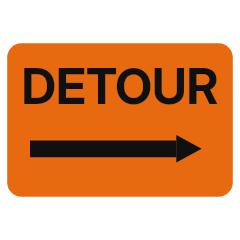
39. Which of these is true of the roadway a driver is being sent onto here?
Show answer
Answer D: Its own signs, signals and speed limits govern for the whole way around
The alternate route is an ordinary public road, so every control posted on it governs as usual; being sent that way grants no extra priority and no relief from the limits in force there.
-
40. How much following distance should you keep behind a motorcycle?
Show answer
Answer C: At least three to four seconds
A motorcycle can slow or stop very quickly and is easily upset by a surprise, so allow three to four seconds instead of the usual car gap.